

How Good Teachers Get Broken
The Hidden Curriculum Schools Teach Their Teachers
I don’t think it’s a big reveal, but I love comics. I grew up reading comics, spent about 15 years working in the industry, and I'm still in love with them. One of my favorite publishing experiments in recent years has been DC’s Absolute line. While they’re all pretty great, Absolute Martian Manhunter is a standout in its weird, psychedelic glory, and I’m so there for it.
And then… in issue #3, this sequence punched me in the face.
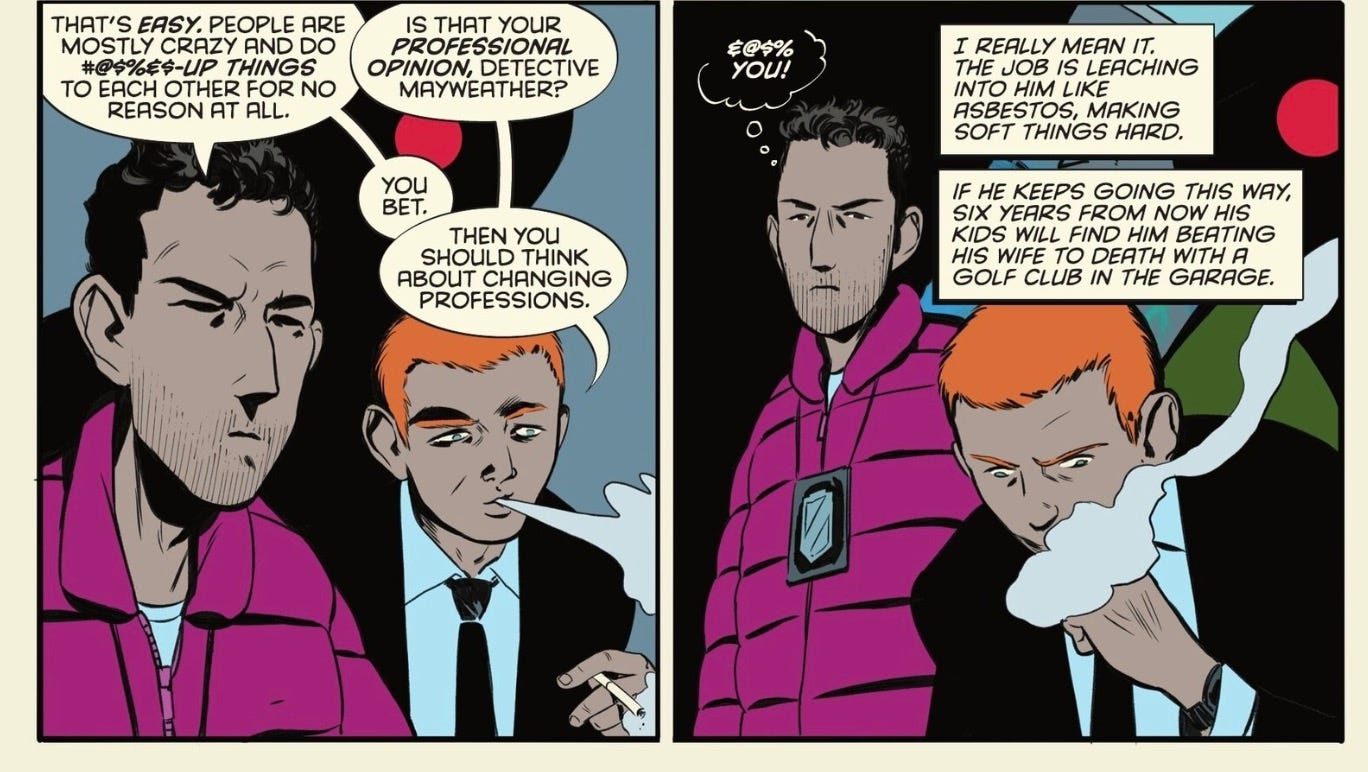
Okay, minus the golf club stuff, I think a lot of teachers have had similar conversations or listened to similar rants. In my spicier moments, I’ve even interrupted a colleague mid-rant to ask, “Do you even like kids?”
Sometimes I am a delight.
But that asbestos line. It wouldn’t leave me alone. Sometimes, we let something poisonous take root and grow. The soft stuff becomes hard.
It reminded me of something I think about my students all the time. Remember those eager kids in their elementary school pictures? Smiling, full of excitement and promise? Yeah — none of them are going to school planning to become the kid that skips class and leaves with a GPA of 0.75.
Likewise, nobody comes into teaching wanting to be a martyr or a cynic. So where do they come from?
I feel like it’s one of the oldest questions in biology: are we born this way...or does our environment make us this way? Maybe it’s a question of nature versus nurture.
If that’s true, then maybe martyrdom and cynicism aren’t personality traits at all. Maybe they’re just an evolutionary line that begins with the creature called “a good teacher.”
The Dark Evolution Line
Let’s think of it this way…
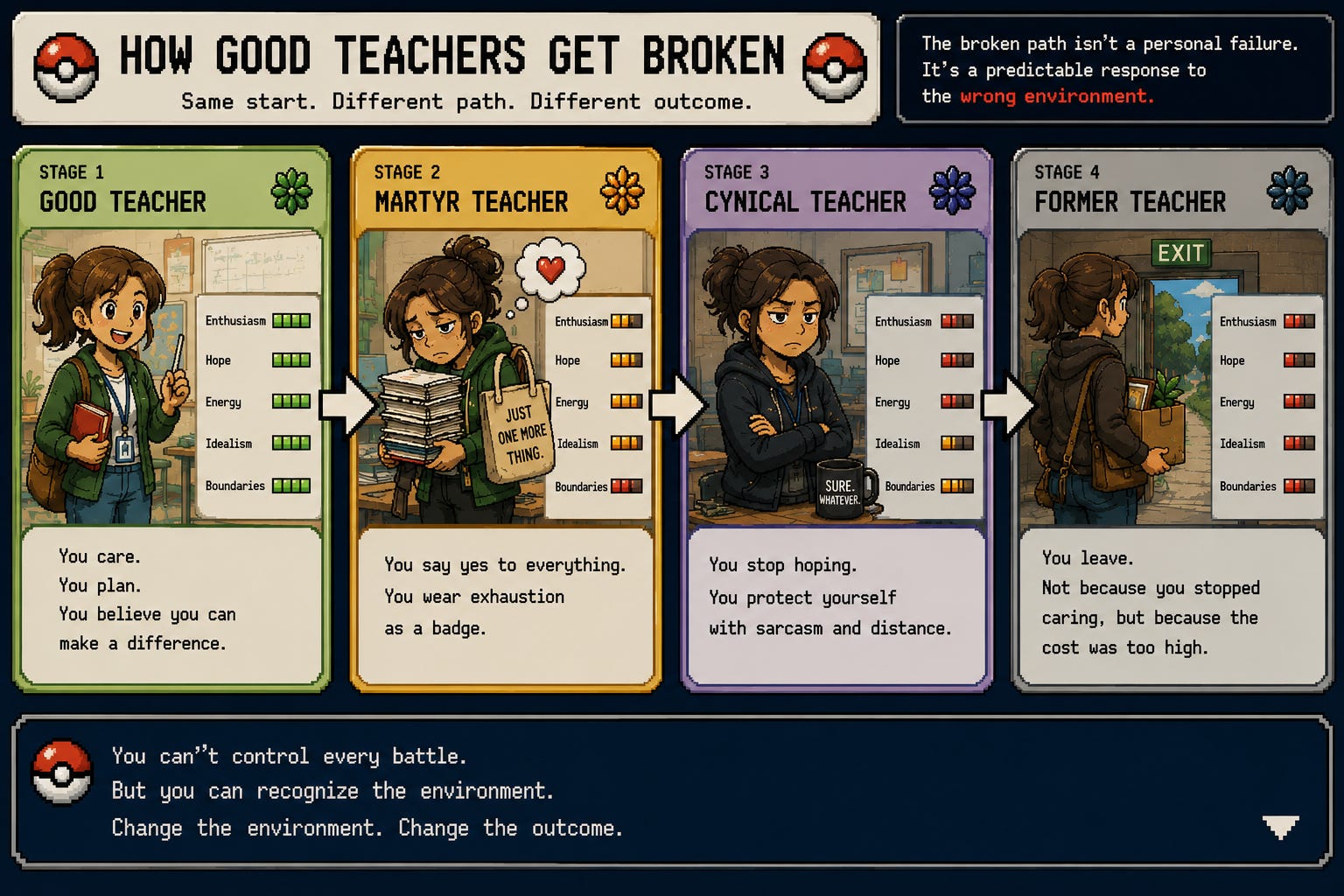
We all start as good teachers. At this point in history, almost nobody is getting into teaching because they hate kids or hate teaching. But the dark evolution line is always there. And almost no one ever notices themselves evolving.
I don't see martyr teachers and cynical teachers as opposites. They're less opposites than successive evolutions. The martyr believes every problem can be solved with more of themselves.
They say yes to everything because every appeal to guilt works. (“we’re here for the kids,” “we’re a family,” “we’re in it for the outcome, not the income,” or “well, I guess you just don’t care about kids’ education”1) and the job expands to fill every spare minute
Sacrifice = commitment.
Getting into email brawls with parents at 11:00 pm? Sure. Up at 4:00 am to get a leg up on grading? How else can you stay ahead?
No one stays healthy as a martyr teacher. Eventually, the bill comes due. Martyr teachers don't just burn themselves out. They redefine what everyone else is expected to do. They normalize burnout.
Eventually, the martyr discovers something terrible: the work never ends, and the evolution continues.
Martyrs become cynics not because they cared too little. They become cynics because caring harder didn’t fix anything.
Now they're the ones snarking in faculty meetings just loudly enough for their table to hear, but not the presenter. Experience becomes an excuse to stop imagining things could improve. Hope sounds naïve. And in an organizational sense, cynicism spreads faster than optimism because it sounds like wisdom.
Final evolution: former teacher. Sometimes they’ve left. Sometimes they’ve just checked out. Physically present, emotionally retired.
No one wants to become a martyr, a cynic, or a former teacher.
So… who taught them?
Nature vs. Nurture?
It took me a long time to realize schools have a secret curriculum. There’s one curriculum for students and another for teachers.
Schools teach teachers how to be teachers. It's just not written down anywhere.
(I've written before about how schools often pass culture along far more effectively than they pass along best practices.)
And I am so not talking about PD.
Teachers learn professionalism by observation.
The funny thing about culture is that it's always teaching.
I hope you’re all having the same “duhhh…” moment I did. We know students learn more from what we model than what we preach. Why would teachers be any different?
How to Build a Martyr
It’s easy, really. Every good teacher has the seeds; all you have to do is feed and water them. Don’t get me wrong here — I’m not Martin Luther, and these aren’t my theses against district and school leadership. No single person creates a martyr (at least I hope not). Martyrs are created by a mix of competence and culture.
Some of these things come from principals, some from mentors, some from veteran teachers, department chairs, or other martyrs.
It’s a combined effort.
Step 1: Praise sacrifice, not results.
Step 2: Send weekend or off-hours emails. Not because people read them, but because they see them. Every Sunday email quietly teaches a first-year teacher what "professional" looks like. Timestamps can teach more than speeches.
Step 3: Celebrate heroes, and never fix the systems they’ve triumphed over.
Step 4: Keep adding. Never subtract.
Step 5: Wrap every request in “Do it for the kids” to justify everything. Every exploitation of teachers arrives wearing a child’s face.
Step 6: Reward availability, and call it “dedication.”
Step 7: Make sure the finish line keeps moving.
Congratulations!
You’ve built a martyr who knows that the work never ends.
Now let’s turn that martyr into a cynic.
How to Build a Cynic
Just like building a martyr, it’s not hard. Start with someone who cared too much, asked too much of themselves, and believed effort could fix almost anything.
Then teach them otherwise.
Step 1: Make the workload impossible.
Step 2: Keep launching new initiatives without closing out the old ones.
Step 3: Never let anything finish. No reflection. No follow-through. No visible wins.
Step 4: Let every good idea die in committee, turnover, or “we’ve always done it this way.”
Step 5: Treat teacher feedback like it’s decoration.
Step 6: Make sure the same problems return every year, wearing different acronyms.
Step 7: Allow the loudest veteran in the room to greet every possibility with, “That’ll never work.”
Congratulations!
You’ve built a cynic.
Cynicism is what hope looks like after enough disappointments.
The Other Evolution Line
Let’s flip the script:
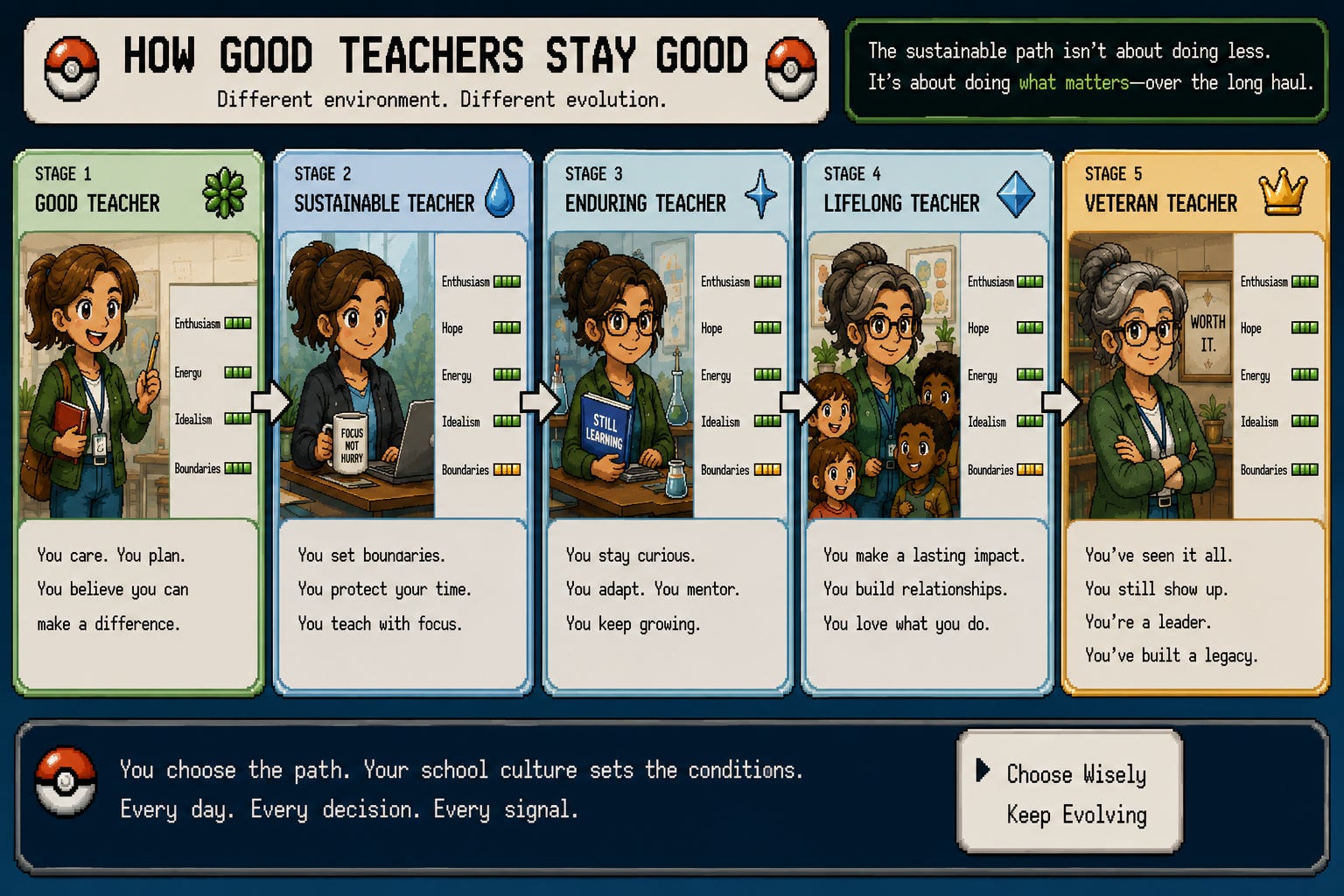
We can stay good teachers, though. I want to think most of us do.
Boundaries keep the job in its own box. That box might creak or bulge and throw out a tentacle now and then, but those boundaries make everything else possible.
It’s the easier path, too. Stay curious. Adapt. Let experience make you wiser, not harder. There’s still hope in you. You still believe that effort matters. You see the long game.
The difference between these two evolution lines isn’t talent. It’s the environment they’re raised in and the habits they pick up along the way.
I don’t believe any of the teachers in this pathway care less. They’ve just learned what deserves their care. Learned the hard-won lesson that they don’t have to fight every battle in the school or district.
Sustainable teachers don’t love teaching less.
They love it long enough.
How to Build Veteran Teachers
This is a school and district culture issue, not just a leadership issue. Every teacher, mentor, department chair, instructional coach, and administrator has a hand in shaping a school’s culture because someone is always watching. Not in the paranoid way, but in the hidden curriculum way. New teachers, or teachers new to the school, see what others are doing and adjust accordingly.
If we're serious about growing veteran teachers rather than martyrs and cynics, then everyone has a job to do.
Teachers
Don’t compete in suffering. The job is not the Pain Olympics. There is no medal for enduring the most. Bragging about how hard you work for a job that doesn't love you back is a weird flex. Stop normalizing exhaustion as professionalism.
Schedule your emails. If it isn't an emergency, don't make Sunday night part of someone else's work week. And think about your own boundaries.
Go home. Seriously. It’s not that you don’t care anymore; it’s that boundaries are something newer teachers need to see modeled.
Stay curious. Read. Experiment. Visit another classroom. Steal good ideas shamelessly. Cynicism grows when curiosity dies.
Choose your lunch table carefully.
Stop rescuing broken systems. If a system only works because one exhausted teacher keeps saving it, the system is broken, not the teacher who finally says no.
Learn to say no. To the things that don’t matter. Every “yes” has a cost in time, attention, and effort. Don’t start spending more than you have.
Remember this: students need you next year too.
Leaders
This might get uncomfortable, and I’m okay with that. Teachers… we have agency, but leadership has amplification. Every habit a leader has becomes permission for someone else. And this isn’t an arrow aimed at the chest of principals—this goes out to everyone: department chairs, mentors, APs, principals, district leaders—anyone who shapes culture.
Schedule your emails. If it can wait until Monday morning, let it wait until Monday morning. Your staff doesn't just read your emails. They learn from their timestamps.
Praise efficiency, not exhaustion. The teacher who finishes during contract hours isn't less committed than the one who stays until 7:00. Stop confusing long hours with professionalism.
Protect planning like it’s instructional time because it is. Every meeting you schedule has a cost, and teachers usually pay with evenings and weekends.
Subtract before you add. Every initiative costs time. If you're asking teachers to do something new, tell them what they're allowed to stop doing, rather than just adding to an already impossible pile.
Stop celebrating heroes. Hero teachers make for great stories and terrible systems. If one extraordinary person is holding everything together, the problem isn't the teacher; it's the system that needs saving every day.
Interrupt cynicism. Don't let "That'll never work" become the smartest voice in the room. Experienced teachers deserve to be heard, but experience isn't a free pass to drain hope from everyone else.
Model the culture you want. Teachers believe what you normalize, not what you say in the “Welcome back!” PD in August. Your teachers are watching you just as closely as their students are watching them.
Culture is whatever gets repeated until nobody questions it anymore.
Make the Job Worth Staying For
A minute of full disclosure? I’m going into my 17th year of teaching, and I’ve been both the martyr and the cynic at different points in my career, sometimes to the point where I'm honestly surprised I'm still teaching. I’m sure leadership saw me more as an asshole than an asset for long stretches of my career.
And the dark evolution still pulls. I’m teaching two new classes this year, and to be totally honest, I’ll probably drift toward the martyr a little to make sure I get things right and do the best for my kids.
But I've got better boundaries now. More experience. I've seen things get really bad, and I've seen them get really good. And most importantly, when I feel that snarky comment bubble up, or the urge to burn a little more midnight oil, I know one simple truth:
It doesn’t have to be this way.
I don’t have to go down that road. Neither does the teacher across the hall, nor does the first-year teacher who starts their career next month.
School’s going to start up for the ‘26-’27 year before too long. Somewhere in your building, there will be a first-year teacher.
They’re watching. Watching when you leave. Watching how you talk about kids. Watching how you respond to bad ideas. Watching how you answer emails. Watching what gets praised. Watching what gets ignored.
They’re learning how to become teachers.
The question isn’t whether you’re teaching them. The question is what you’re teaching.
Let's teach them that being a great teacher shouldn't require becoming a broken one.
The classroom is where I do the work.
The Science Of is where I chase the questions.
If you’d like more stories about science, dinosaurs, asteroids, history, space, comics, and the strange connections hiding between them, come join me over there.
Oh, I know, just writing these out, I wanted to say, “Oh, fuck you” to myself. Yuck. Manipulation is never good.
The cynical teacher who retires isn't necessarily irredeemable. Yes, I'm talking about myself. I'm now empowered. I am collecting my pension and a paycheck. Nothing can stop me now. I'm there because I want to be there and because there's no one to replace me. How are they going to justify taking me out? There aren't even enough subs to cover our normal absences.
When they come up with another rebranded previously failed initiative, I ignore it and I close my door and teach. I teach my way. I teach creatively. I experiment. And every single morning, I greet my kids by name in the hallway and I never fail to do the little things like hall duty. I keep my mouth shut during faculty meetings because I know what I say would be taken badly or worse, as a challenge to the status quo.
I don't try to lead. I used to do that. Before I retired, I was on every committee, and chaired most of them at one time or another. I was a union rep. But in August, it will be 39 years since I became a teacher. If I am actually asked a question in a PLC meeting, I answer it and no more. I don't volunteer. Is that selfish? Maybe, but I did my time in the front. Now, I do what I actually set out to do as an undergrad.
I teach.
Retired veteran teacher here, and I will say that your chart on keeping teachers without becoming martyrs/cynics is totally accurate. I worked for 41 years and ended up still loving what I did. Along the way, I encountered the martyrs—worked with many! - and the cynics—sad. It's a hard thing not to buy into the martyr syndrome, especially when your closest colleagues are of that sort. But it's important to do that hard thing: set boundaries. Even harder: not to compare yourself, feel guilty, or give in. But it's what kept me going for all those years, plus, as you add, keep learning and being curious. I always told my newer (okay, younger) colleagues that when you stop learning, you need to quit. You never "arrive" as a teacher; you always have something new to learn; there are always new revelations through science and research, always new things to learn from other teachers, always new things to learn about reaching all your students. I wish this were required reading this year in particular for the "powers that "be"—the principals, district leaders, superintendents, etc.—to understand their role in supporting this. Loved it.