

Response to: Why Gen X Shouldn't Be in the Classroom
Public Education Doesn't Have Too Many Veteran Teachers. It Doesn't Have Enough.
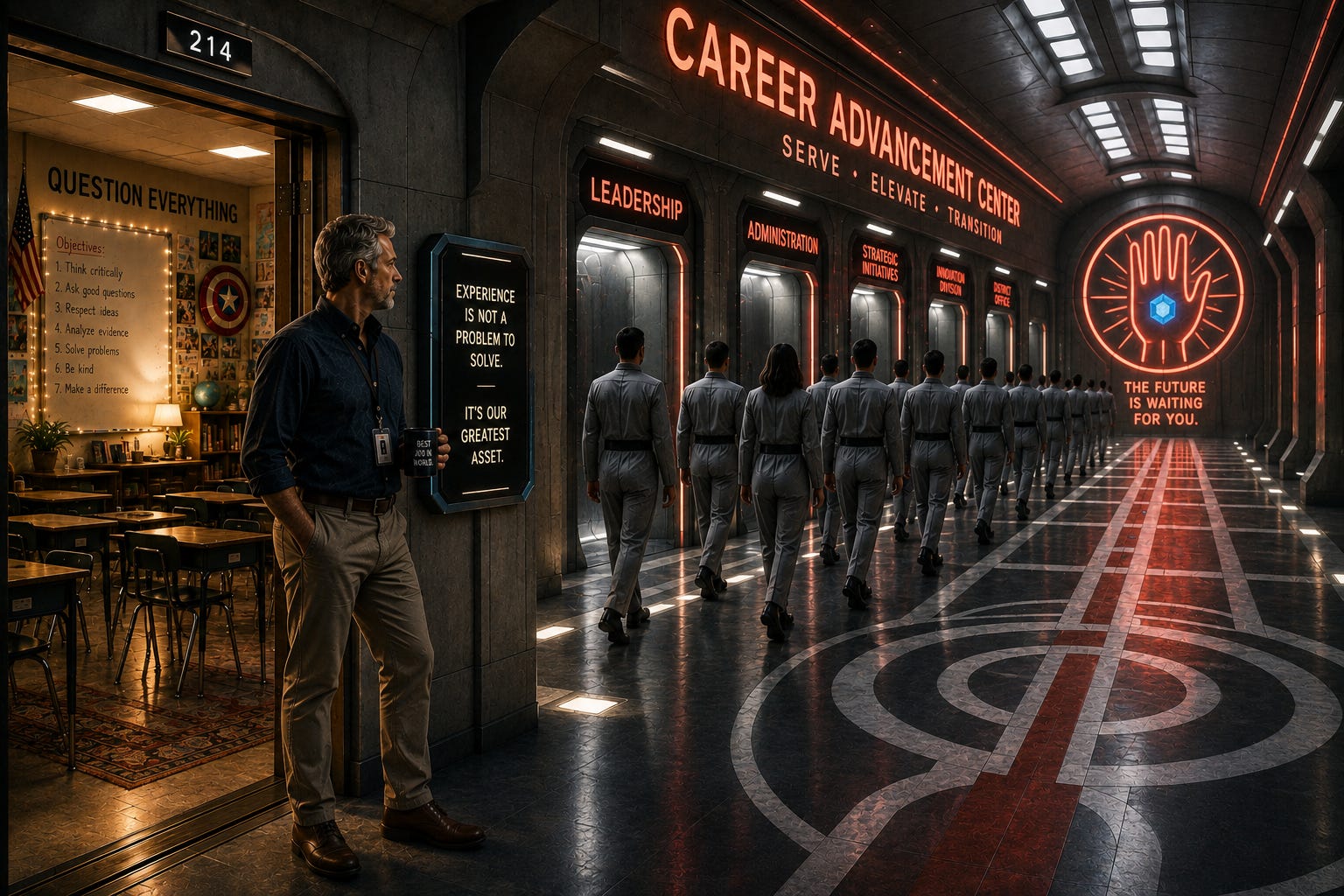
Okay, I’m not sure how this works.
I’ve been at Substack for (checks history) about two years now1 and I saw something in my feed the other day that got me thinking.
Do we do answer backs?
Maybe other people responded when this article first went up (August 12, 2025), but this one landed close to home.
The post is/was Jennifer Smith’s “Why Gen X Shouldn’t Be in the Classroom.”
Oh, I get it. I do. The title was designed (and maybe A/B tested) to get responses, and here I am pushing the lever exactly like I’m supposed to.
This article isn’t a Kendrick track aimed at Drake. I don't have beef with Jennifer. I don’t think we’ve ever even spoken. The article rings a bell hard with the title and then, its work done, settles into a thoughtful argument.
At its heart, Jennifer argues that education wastes expertise. Experienced teachers accumulate knowledge and skills that could benefit entire schools and districts, yet the profession offers few pathways beyond the classroom other than administration. She argues that schools should create specialized leadership roles that allow veteran educators to influence curriculum, mentoring, innovation, and school improvement without forcing them onto the traditional administrative track.
Honestly, I agree with almost all of that. In fact, if education worked the way most professions work, I'd probably agree with all of it. But Jennifer’s proposal assumes a profession that is structurally healthier than the one we actually have. And once you start looking at the profession as it exists, not as we wish it existed, many reasons emerge for why Gen X teachers remain in the classroom.
But first…
Who Are Gen X Teachers Again?
By demographics, Generation X is the children of the Silent Generation and/or the Baby Boomers. Pick any meme or TikTok explanation of who Gen X is that you like, but in terms of numbers, we’re talking about folks born between 1965 and 1980. In schools, those are teachers aged roughly 46 to 61 (as of 2026).
Some of us started hitting 30 years in the classroom around 2017. Most will reach that milestone over the next decade or so, often with one eye on the "Rule of 85" (age plus years of service equals 85) and the pension benefits that come with it.
Retirement as a teacher is its own anxiety-inducing quagmire, and I'm really not interested in wandering into that swamp today. The one thing I do know is that it’s never too early to start planning.
Some of us got into teaching right out of college. Some (like me) came to teaching as a second (or third) career through a variety of programs. Mine was "lateral entry," though the name and rules have changed about three times since then.
As a group, Gen X teachers represent a significant age demographic in American public education, where the average teacher is about 43 years old2. Population shifts and fewer people entering the profession will change those numbers over time. Still, the average age of teachers is more likely to rise than fall—even as Gen X reaches full retirement age and job dissatisfaction remains high.
So we're here. And for the foreseeable future, public education is going to rise or fall with a lot of Gen X teachers still standing in front of classrooms. We are, increasingly, the people who remember how the system worked before the latest reform, initiative, platform, framework, dashboard, screens, and the crisis of the week.
There are three broad categories of reasons why we stay.
Reason 1: The Pipeline Problem
If not us, then who?
No, seriously. Who?
Touching back on Jennifer’s article for a moment, it assumes a surplus of experienced educators waiting to be redeployed into leadership pathways, along with a large influx of baby teachers to take their places in classrooms. That’s not my lived experience at all. Every year we have openings, and every year we struggle to fill them.
Many times, we rely on experienced teachers from other schools in the district or out of district to fill our staffing gaps. “Experienced” most often means Gen X, just from other schools (which now go into an expertise deficit).
The reasons we don’t have a surplus of experienced educators are… well, we can all recite them by heart.
Teacher shortages in general: Every year, districts scramble to cover vacancies, combine classes, increase class sizes (we’re now at 40!), or ask existing teachers to absorb more responsibility (“Do more with less!”). Before we move experienced teachers into new leadership roles, we have to confront a simple reality: someone still has to teach the students.
Declining enrollment in teacher prep programs: After years of taking hits from every direction, fewer people are choosing teaching as a profession. The pipeline feeding the profession is narrower than it used to be. You can't build a deep bench of future experts if fewer people step onto the field.
High attrition among early-career teachers: It takes 10 years to grow a good teacher. Many new teachers never reach the point where they become experts. A significant percentage leave within their first five years. That's not enough time to master classroom management, curriculum design, assessment, parent communication, and the thousand other skills that make teaching look effortless from the outside.
Political hostility: Teaching has become a profession where strangers feel comfortable explaining to us how schools work. Curriculum decisions become political footballs. Teachers are accused of indoctrination, laziness, incompetence, or worse. It is difficult to recruit people into a profession that increasingly finds itself cast as a cultural villain rather than a public good.
Compensation issues: No teacher gets rich teaching, and most of us knew that going in3. The problem isn't that teachers expected to be millionaires. The problem is that compensation often fails to keep pace with the expertise, responsibility, and education the profession demands4. At some point, idealism collides with mortgage payments, childcare costs, and retirement planning.
Burnout: Teaching asks people to be educators, counselors, mediators, data analysts, customer service representatives, technology troubleshooters, and occasionally miracle workers. Most teachers can handle any one of those jobs. The challenge is being asked to perform all of them simultaneously, year after year. Eventually, even the people who love the work start looking for an exit ramp.
None of these problems are new. None of them is particularly controversial. And all of them make it harder to produce the very pool of experienced educators that Jennifer's proposal depends on.
Many Gen X teachers aren’t remaining in classrooms because they’re trapped there. They’re remaining because somebody has to. We're the last generation with a clear memory of schools before smartphones. We remember classrooms that weren't mediated through screens. We remember when public education was widely regarded as one of the country’s strengths rather than a favorite punching bag.
I hate martyr-teacher culture with the heat of a million suns. But I also know that many of us are still here because we believe public education is worth fighting for.
Reason 2: The Confidence Problem
We’ve become a profession that no longer trusts itself.
Some days I think that's by design. Other days, I think it's because too many people who couldn't make it work in classrooms found their way into positions where they could tell classroom teachers how to do their jobs.
Hypothetical leadership pathways like Jennifer suggests assume teachers are viewed, and view themselves, as professionals whose expertise is valuable. But the larger education system has spent decades undermining teacher authority.
What we're left with is a profession increasingly built on baby-birding: here's your lesson, here's your content, here's your gamified EdTech tool. Now go teach. And don't think too hard—we've got that part covered.
No wonder some teachers are terrified AI will replace them. We've spent years treating them like they're replaceable and driving home the message that what they do isn’t anything special.
It takes years for the scales to fall from our eyes—if they ever do—and for us to realize that we are the experts. In our content. In our pedagogy. In teaching itself. Saying that out loud feels almost rebellious because teachers aren't really supposed to think that way.
“But wait,” you say. “Are you saying there’s no room for improvement?”
I know, I know. "A culture of continuous improvement5." We can all get better. Sure. Have you noticed that when people talk about continuous improvement, they often don’t mean themselves? Somehow "we" always turns into "you." Or, at the very least, the pathway for how they’re going to improve themselves is never mentioned or listed with bullet points like ours.
The thing about Gen X is that we’ve started to realize all of this—we know more about teaching (and often running a school) than the people who are telling us how to teach. It’s why we can be a riot at meetings6. Part of our charm.
But let’s run down the interlocking gears of “how to destroy teachers’ confidence 101.”
Constant evaluation: We are one of the few professions where someone can walk into your workplace for twenty minutes, twice a year, and generate paperwork suggesting they know how effective you are. Do that long enough, and you start questioning your own judgment. And sanity.
Scripted curricula: At some point, "support" became a binder that told professionals exactly which page they should be on this Tuesday. It's difficult to feel like an expert when you're treated like a delivery system.
Political attacks: Depending on the week, we're either indoctrinating children, lowering standards, destroying America, or all three at once. It turns out that being treated as a cultural villain isn't great for professional confidence.
Public distrust: Every teacher has heard some version of, "Well, when I was in school..." as if attending high school once qualifies someone to redesign education. We work in a profession where everyone thinks they're an expert because they were once a student.
Consultants: I've sat through presentations by people explaining engagement, motivation, and learning, with no idea what it's like to teach three classes back-to-back on a Tuesday in October. Expertise somehow always seems to belong to the person with the PowerPoint, regardless of how many years they’ve been out of the classroom.
Initiative fatigue: If you've taught long enough, you've watched the Next Big Thing arrive, save education, and quietly disappear three years later. After a while, survival looks less like enthusiasm and more like waiting to see if this one sticks.
Decision-making concentrated elsewhere: The people closest to the students are often the furthest from the decisions. Nothing undermines professional confidence faster than being told your input is valued right before someone else decides for you.
So yes, I agree with Jennifer's central point. There is an enormous amount of expertise sitting in American classrooms right now. But the number of teachers who possess expertise is much larger than the number who have been allowed to feel like experts.
You cannot build leadership structures on top of a profession that has been systematically taught to doubt its own judgment.
Reason 3: The Destination Problem
At the end of the day, some of us are already where we want to be.
Like a jillion other people, I read The Midnight Library by Matt Haig. I’m not going to spill any major spoilers7, but my main takeaway from it was something that I adapted to my job and have expressed to many people:
Sometimes you find that you’re in the right place, doing the right thing for the right people at the right time. And you decide to stay8.
Is teaching in a public school high school classroom perfect? Nope. Not by a long shot. Would I ever leave it? Nope. Not by a long shot.
I matter here.
People I’ve run into who scoff at that9, I think, are looking for a fight or something I’m not going to give them. But ultimately, I feel sad for them. The fact that they get angry at me isn’t rooted in my shortcomings. It’s rooted in their jealousy.
And I’m not saying that’s what Jennifer’s article was implying. Not at all.
But the article assumes that advancement means leaving the classroom in exchange for broader influence.
Many veteran teachers reject that assumption, based on lived experience.
We’ve all seen teacher leaders move into leadership roles and become spineless. Ineffective. A cog in the larger machine we used to rail against over beers after a particularly awful week of bad leadership decisions and micromanagement from above.
Oftentimes, there’s a reason a school system isn’t moving in a progressive direction that benefits all — the district is too heavily invested in going the other way, despite data and evidence showing it’s wrong. And crusader teachers who challenged the system? Gristle under the district’s treads.
That’s not true of everyone, of course. Some become outstanding administrators and leaders. But after approaching thirty years in education, many Gen X teachers have had a front-row seat to what “moving up” actually looks like. And for a lot of us, it turns out the reasons we stay in classrooms are more complicated than a lack of ambition.
The classroom is the work: For many of us, the classroom isn't a stepping stone to something else. It's the thing. We didn't spend decades learning how students think, learn, struggle, and succeed only to spend our days in meetings about spreadsheets and making sure we follow district mandates to the letter.
Patronage and politics often influence advancement: We all want to believe promotions are based entirely on merit. Sometimes they are. Sometimes they're based on relationships, visibility, timing, and knowing which initiatives to support at the right moment enthusiastically. And having the correct patron in the district offices to make sure you get that coveted assignment, whether you’re qualified or not.
Some teachers have already seen management and consciously opted out: A lot of veteran teachers aren't refusing leadership because they're afraid of it. They've watched it up close for years and made an informed decision that they'd rather work with students than manage adults.
Not enough positions exist anyway: Again, even if Jennifer's model were implemented tomorrow, there wouldn't be enough positions for every experienced teacher who might qualify. A ladder isn't much of a solution when only a handful of people can climb it. Gen X is and will be for years, a large chunk of the teacher workforce.
I wish more people knew this, both on the outside and the inside of the job, but the classroom is not the minor leagues for leadership. It’s a weird thing when you catch a whiff of that idea, that the reward for becoming great at teaching is leaving teaching10.
For many of us Gen Xers, we remain in classrooms not because we lack ambition, but because we have already decided where we can make the greatest difference. We’ve seen the leadership world, even Jennifer’s hypothetical one11, and have said, “no.”
Holding the Line
So…yeah. Hope this doesn’t come off as a diss track, but that title of Jennifer’s piece…
“Why Gen X Shouldn’t Be In the Classroom”
…it did its job. It was provocative. I was provoked.
She's right about her central idea: our education system underutilizes expertise.
But the answer isn’t to start hollowing out our classrooms by moving some of the most effective teachers into new leadership positions. Before we create any new leadership pathways, we have to answer three harder questions:
Who is replacing the experts we move out of classrooms?
How do we rebuild a profession that no longer trusts its own expertise?
Why do we assume the classroom is a place people should eventually leave?
I don’t have perfect answers to any of those questions. If I did, I’d probably be writing policy papers12 instead of a Substack. But after nearly two decades in education, I've become convinced of one thing: the classroom is not where expertise hides. It's where expertise lives.
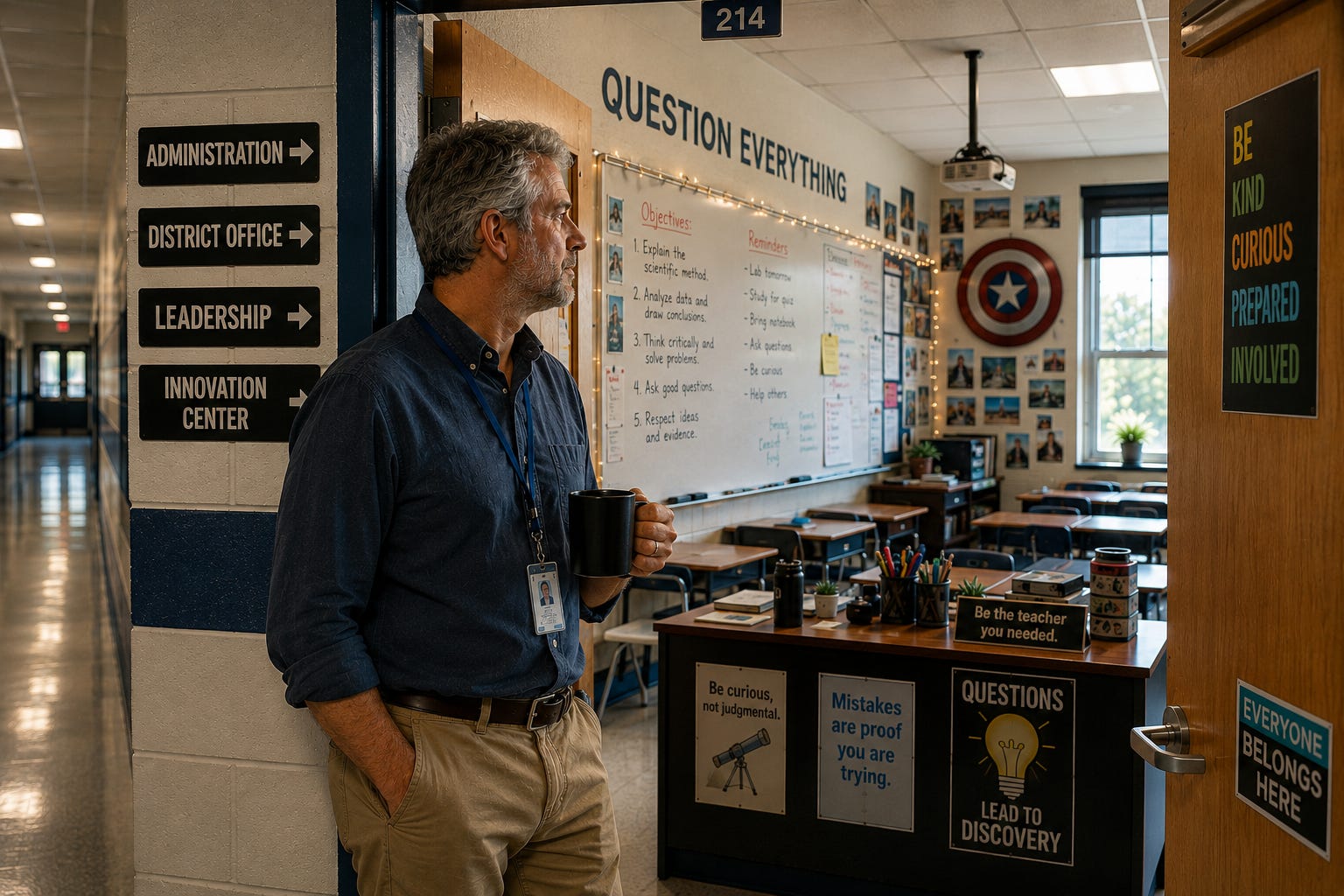
Every day across the country, there are teachers quietly doing remarkable work. They’re mentoring younger colleagues between classes. They’re redesigning lessons. They’re solving problems no consultant, politician, vendor, or AI tool knows exist yet. They’re leading already. They happen to be doing it from Room 214 instead of an office.
Maybe Jennifer’s vision is part of the future. I hope it is. I hope we find better ways to recognize expertise, share knowledge, and create paths for teachers who want them. Public education desperately needs more opportunities, more trust, and more reasons for talented people to stay.
But I also hope we never lose sight of something equally important.
Some of the most ambitious, knowledgeable, and influential educators in the country are exactly where they want to be.
Not because they’re stuck. Not because they couldn’t move up. Because after seeing the whole chessboard, they’ve decided the classroom is still the square where they can do the most good.
So for now, we'll keep holding the line.
Because somebody has to.
So, for many of us aging Gen Xers, we’ll keep on doing what we’re doing. Teaching kids. Sharing what we've learned. Trying to leave the profession a little better than we found it. And believing, stubbornly, irrationally, and against all available evidence on some days, that public education is still worth fighting for.
The classroom is where I do the work.
The Science Of is where I chase the questions.
If you’d like more stories about science, history, space, comics, and the strange connections hiding between them, come join me over there.
I started with a 6-ish-part series about how I tried to get either my school or the district to go phone-free, and how abysmally it failed at every single level, despite the district (and later the state) adopting “phone-free policies” for schools. The adoption of weaksauce policies gave them all an opportunity to appear in pictures and on the news smiling and talking about how they were “helping the kids” while giving the kids and the teachers exactly nothing at all that was, in fact, helpful.
It was raw and filled with cursing and footnotes, both of which I have learned to tame a little. A little. The series was called “brave” by folks in my school and district who hide in their shells and worship the status quo, “really long” by people who read it all, and “a rant” by school and district leadership who, in the end, would do nothing about phones in schools other than watch our kids get more hopelessly addicted. At the same time, they came up with increasingly Draconian punishments for them. Yay. It was a good time. I meant it to be a one-off. And here we are. Still.
It’s hard to tell the difference between young Gen X and older Millennials. Younger Millennials, though. Don’t get me started.
And I get it. Becoming Board-certified to get a pay bump while staying in the classroom is one option, but sadly, many of my colleagues opted for the admin/leadership route, which, yes, is the pathway to higher pay while still working in public education. But…when I see effective, good teachers wanting to go that way, it still breaks my heart.
Anyone else getting an election-year raise this year? In North Carolina, our GOP, which runs the state like their own little third-world country, is floating an idea of a huge raise for teachers, which means teachers in years 1-5 will get a double-digit bump, while teachers with 15+ years of experience will get slightly dented canned goods from Food Lion that can no longer be sold at full retail. All the politicians are smiling for cameras, talking about how progressive they are and atta-boying each other so that we hopefully forget that they neglected to create a state budget last year and have done everything they can to destroy public education as a career and institution for the past 20 years, while driving our state’s corporate tax rate down to zero as fast as they can.
What could possibly go wrong?
AKA - “Burnout Road.”
Had a pal once — he was a great middle school science teacher (kids with top GPAs and full-ride scholarships would go back to his school and thank him for what he did), but a little prickly. As per usual, he got into it with a new principal at their school, and just leaned back in his chair and waited for the principal to blow themselves out. When they did, he just smiled and said, “Look, that’s all good, but I’ve been here through three principals before you, and will be here for probably two more.” The principal didn’t know what to say, and, in the end, my pal lasted for two more principals after that guy.
Who is no longer a principal.
Even though you should have read it by now, I mean, come on, the movie is in the works with Florence Pugh attached. You’ve got to step up your game of being one of those “Yeah, but the book was better” people. I mean, you think I’m reading East of Eden this summer for fun?
Okay, I am — it’s really, really good, but still.
Okay - that might be a spoiler, but I did warn you.
Mostly jackasses doing drive-bys on socials.
I’m not arguing the converse here, but in my experience, strong, effective teachers who develop terrific relationships with students and innovative, effective ways to reach kids rarely leave the classroom. If you feel that means I’m arguing that those who leave the classroom for leadership tracks don’t/can’t do those things listed above?
Go with your instinct.
Creating hypothetical leadership jobs in education is a hobby of many teachers. “If I could just be in charge of…”
I mean, Bart sold his soul on eBay, so I assume there’s still a market for them. I could sell my soul and then start writing policy. Yeah.
As a fellow GenXer, I enjoyed this article...I guess...whatever.
;)
I like being a teacher, why leave something I enjoy and have spent decades getting good at?