

What I Won’t Apologize For
On Refusing False Guilt in a Broken System
Wondering how I got to this? Check out the past three Teacher, Teacher essays:
For most of my career, I apologized constantly.
Sometimes out loud. Sometimes, just in my posture.
I apologized for grades that reflected performance. Apologized for deadlines that mattered. For consequences that arrived exactly when they were promised. I apologized when a parent’s email came in hot, and I could already feel myself writing a reply to smooth things over rather than tell the truth. I apologized when an administrator stood in my doorway, using a tone that said, “You’re not wrong, but you’re being inconvenient.”
None of those apologies were about harm. They were about discomfort.
Over time, I noticed how automatic they’d become. The apology arrived before I’d even decided whether I’d done anything wrong. That’s when I realized the problem wasn’t my teaching. It was the role I was being asked to play.
This isn’t a defense of toughness or tradition. It’s a refusal.
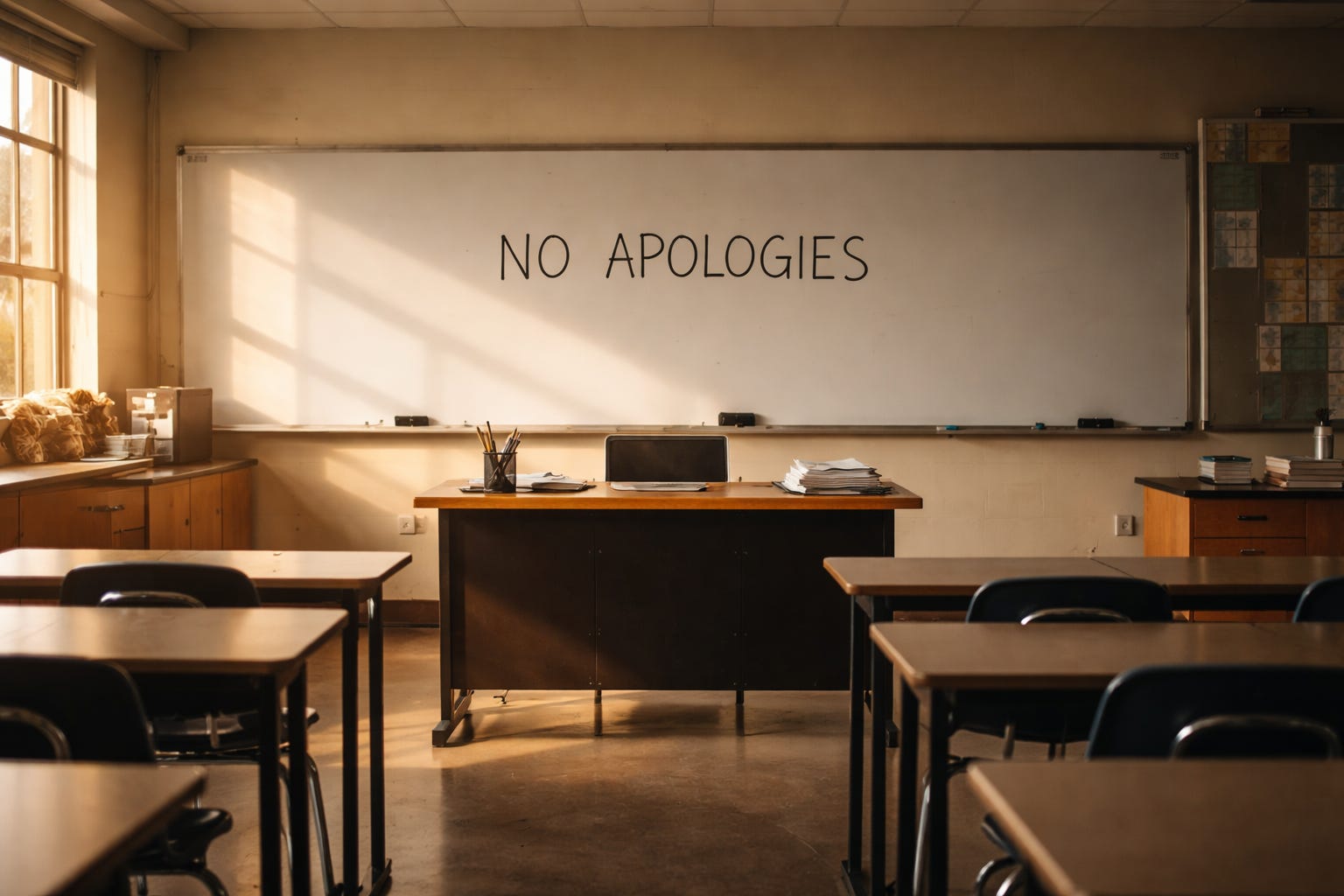
I’m done apologizing for doing the job correctly inside a system that prefers comfort to honesty.
The Apology Economy in Schools
Schools run on apologies that are never named as such.
They appear in conferences where everyone knows the student didn’t do the work, but the conversation bends away from accountability and toward “what else we could have done?” They surface in meetings where expectations are quietly lowered—not because they were wrong, but because holding them would create friction. They show up in emails where teachers absorb responsibility for outcomes they don’t control.
I’ve written those emails. I’ve sat in those meetings.
These apologies don’t repair anything. They keep the system emotionally solvent. Tension that should be addressed structurally is redistributed to individual teachers, who are expected to carry it privately and then apologize for causing it.
I, not so politely, decline.
Professional Judgment Is Not a Moral Failure
There’s a fiction in education that good teaching requires constant self-doubt. That confidence is arrogance, ego, or the lack of a “growth mindset.” That firmness signals a lack of care.
I believed that for a long time. I wore uncertainty like proof of virtue.
Experience changes that. Not because you harden, but because patterns repeat. You see what works, what fails quietly, and what fails loudly. You learn that some discomfort produces growth, and some exists only to reassure adults.
At some point, teaching stopped feeling like performance and started feeling like practice. Not louder. Not harsher. Just clearer. Teaching wasn’t my job. I was a teacher.
That clarity didn’t make me less human in the classroom. It made me harder to emotionally coerce.
I Won’t Apologize for Expectations
Expectations aren’t punishments. They’re promises.
They tell students what matters and where effort belongs. I’ve watched students rise to standards I was told were unreasonable. I’ve also seen what happens when expectations are removed “for their sake”: confusion increases, motivation erodes, and the students who are trying feel foolish for doing so.
I won’t apologize for asking students to stretch. Growth without tension isn’t growth. It’s just activity. Movement.
I Won’t Apologize for Consequences
A consequence isn’t a judgment of character. It’s information.
When deadlines don’t matter, time dissolves. When effort is optional, learning becomes cosmetic. I tried softening consequences for years. All it produced was drift.
I won’t apologize for letting outcomes reflect decisions. For being the FO to students’ FA. That isn’t cruelty. It’s honesty.
I Won’t Apologize for Not Performing Enthusiasm
I care deeply about my students. I just don’t perform that care theatrically anymore.
Calm competence is not disengagement. It’s steadiness. There was a time when I thought good teaching required constant animation—energy on demand, warmth on display. What I learned is that performance replaces something more durable: presence.
I understand why teachers adopt that posture. I lived there.
This is not that.
I Won’t Apologize for Protecting Time and Attention
Time is the scarcest resource in a classroom. Attention is the most fragile. We’re often told this by the people who take it from us regularly, sometimes as they’re taking the time from us.
Every interruption has a cost. Every distraction trades depth for ease. Protecting the conditions that make thinking possible isn’t the same as rigidity. It’s respect for the work and for the students who are trying to do it well.
I won’t apologize for that.
I Won’t Apologize for Saying No
“No” is a complete sentence. And it’s sometimes the most honest answer available.
I used to soften it endlessly—explaining, justifying, reframing. What I learned is that clarity is kinder than perpetual negotiation.
I won’t apologize for refusing requests that undermine fairness or learning. Boundaries aren’t hostility. They’re what make trust possible over time.
I Won’t Apologize for Refusing to Confuse Kindness with Permissiveness
Kindness is taking students seriously. Permissiveness is avoiding conflict.
They are not the same.
Real kindness tells the truth about effort, preparation, and responsibility. It doesn’t shield students from feedback to preserve comfort. It doesn’t apologize for asking them to meet the moment they’re in.
I won’t apologize for choosing the harder form of care.
When the Apologies Stop
When teachers stop apologizing for reality, certain things come into focus.
Burnout stops looking like a personal failure and starts reading like a structural one. Boundaries stabilize because they’re no longer negotiated emotionally. Policies hold because they’re rooted in judgment rather than guilt.
Teaching regains its center. It becomes less about managing feelings and more about guiding learning.
This posture isn’t loud. It doesn’t announce itself. It doesn’t seek permission.
It simply declines to perform remorse for doing the job well.
A Different Way of Standing in the Room
This is not how most of us start teaching.
It’s where many of us arrive if we stay long enough, pay attention, and decide that honesty is kinder than performance. The shift is subtle, but students feel it immediately. Parents sense it. Administrators may not have a term for it, but they recognize it nonetheless — and they may bristle at the curtain being pulled back. After all, “You’re not wrong, but you’re being inconvenient.”
But this isn’t rebellion. It isn’t burnout. It isn’t disengagement.
It’s a teacher who has stopped apologizing for reality—and has discovered that, without the apology, the room finally settles.
If you recognize that stance, you already know what kind of teacher I’m describing.
You may already be standing there yourself. I hope you are.
If this resonated, you’re not alone.
And if it unsettled you, that may be worth sitting with.
Thanks for reading.
Next time: One for the Students…
Love this. It is strange how some parts of this profession seem to want teachers to stay "low" or unconfident. I’ve been in those districts where the PLC was a joke and colleagues would rather die than share a resource. It was a baptism by fire that forced me to build everything from the ground up. Now, I refuse to apologize for being competent or for being an open book.
I also refuse to apologize for treating my students with the respect they deserve. I’ve had colleagues walk into my room just to yell at a student for a hallway incident. I don’t yell at my kids because I respect them and I know they can’t learn while they are dysregulated. Some people have forgotten that Rita Pierson truth: kids don't learn from people they don't like.
Maintaining high expectations isn’t mean and being calm isn't "not caring." My students submit much stronger work, because I am clear with them and I treat them like people. I’m done apologizing for the clarity that actually helps them grow. Teachers need more of this energy.
I feel this post so deeply! It resonates so much with my experience.