

The Post That Can Sink 1,000 Cell Phone Bans.
And my...evolution?
I’m an admitted extremist when it comes to phones in schools.
Or was?
I still think that phones should be out of students’ hands, bell to bell. I like to think of myself as a blend of an optimist and a realist who believes that, as a whole, people are good and just, and that over time, they do the right thing.
But my view about phones in the classroom has a weak point.
The tragedy at Camp Mystic in Texas was horrible and a failure of many systems and individuals. However, one thread that emerges hits the phones-in-schools argument right where it hurts. As stated by NeuroDivergent Rebel:
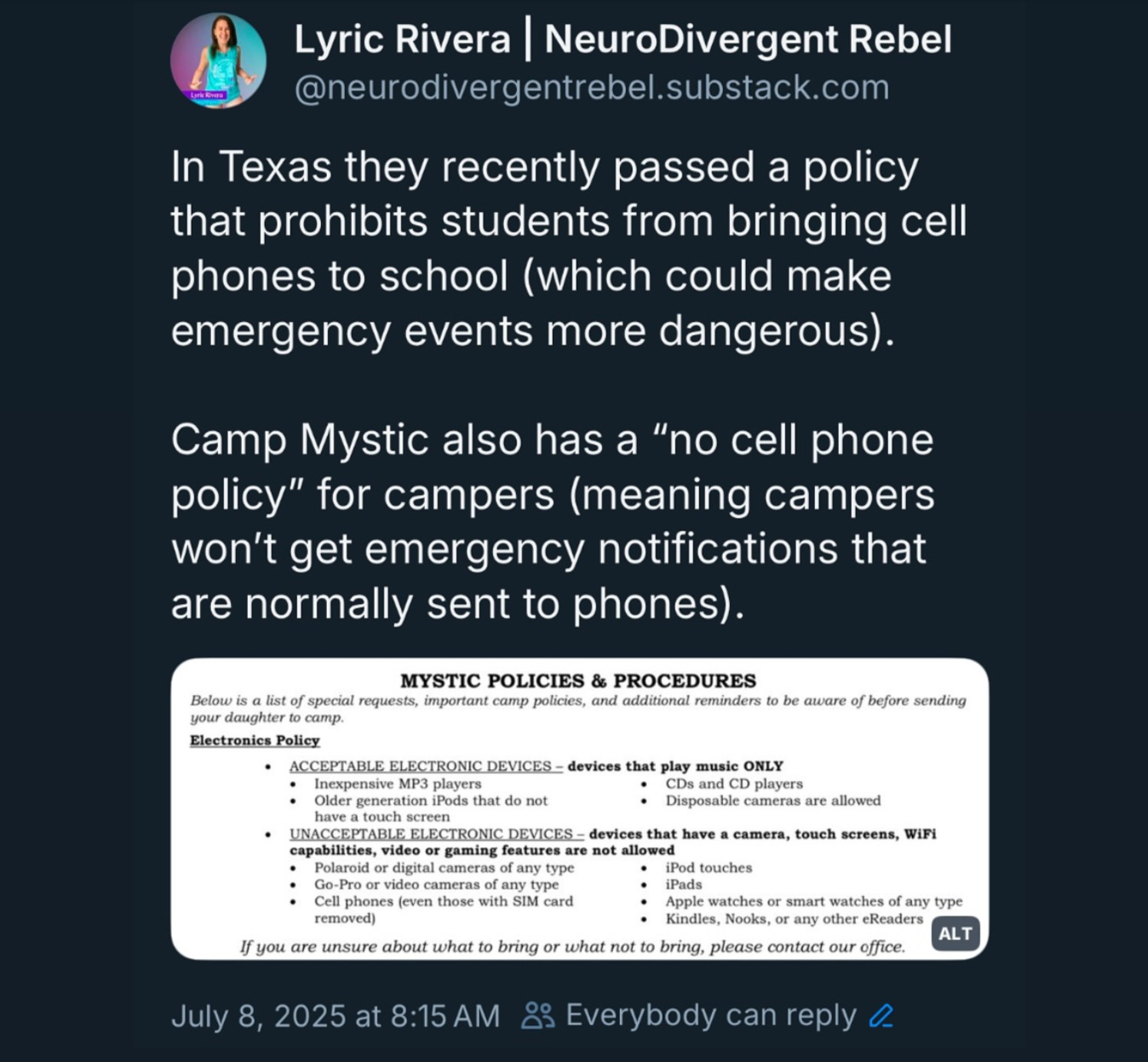
Now, there are some nuances in the above claims that can be considered, such as cell reception and whether warnings were sent, which can be factored into the scope of the tragedy. Also, I don’t want to give the impression that Lyric is a lone wolf with this thought. Over on Reddit, u/myshelly posted in r/Teachers:
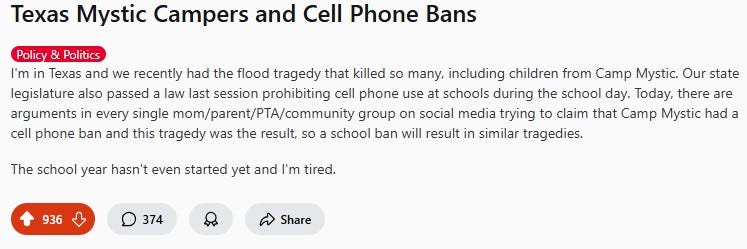
The gut reaction that comes out of this from parents is: if my kid isn’t allowed to have their phone with them at all times, they could die.
I wrote about the phones in the hands of students and how officials feel about them last year, and it remains a heart-wrenching topic to discuss or think about. I’m a teacher, and like all of your kids’ teachers and your teacher friends, I’ve had some horrible thoughts about a school shooting in my school. Horrible.
In talking about the shitty phone policy that my district enacted last year, I talked about a conversation with my tattoo guy that went like this:
Aside from a couple of parents I’ve heard from, parents in general…this isn’t an issue that resonates with them, and in many cases, it's an idea they are opposed to. Let me quote my tattoo guy when I recently said that we need phones out of schools, bell to bell. He has a daughter in middle school, and he looked at me and said,
[noise of sucking air in through their teeth] “Yeeeaaaaah…I don’t know about that one.”
Unspoken, my guy was thinking about his kid’s safety, and that phone being a direct line to him, to help or as a locator if they had to flee the building. He’s not an outlier.
In any district, any county, any state, you’re going to have a solid block of parents (and some teachers) who will know, not claim, but know: schools are unsafe. For these parents, and even spouses of teachers, that last step out the door, bus stop, or car-rider line in the morning may be the last time they see their loved one alive1.
This knowledge comes from two places — most often, a curated stream of news and social media that reinforces their beliefs.2 The second, and horrible, place is from the friends, families, and social networks of actual victims, survivors, or places where it happened.
This belief gets reinforced by a premeditated shooting in a school by students who had beef, a teacher spotting a hidden gun (or said hidden gun going off), or rumors running like wildfire through students’ and parents’ social media3 that there’s going to be a shooting at school. All of that, even the rumor, reinforces the view that the schools and teachers (while they mean well) cannot keep students safe.
What I’m Not Saying…
I am not saying these parents are wrong in their feelings, nor am I trying to discount their feelings and beliefs. In an environment where headlines are horrifying and social media reinforces worst-case scenarios, it’s easy to understand how fear becomes the dominant lens, mainly when that fear is rooted in real tragedies: school shootings do happen.
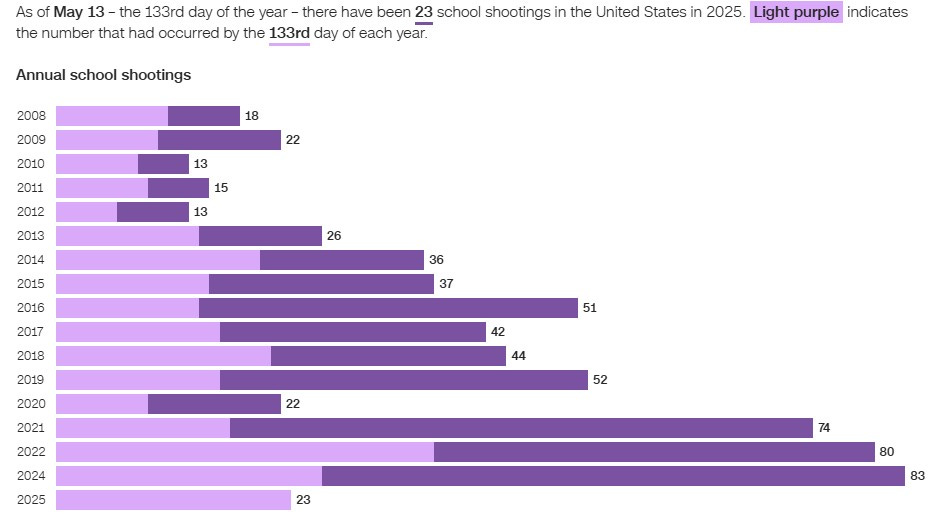
And I’m certainly not saying that parents are wrong to worry about their kids. I’m also a parent (and I work in the place we’re talking about). I 100% get that.
I’m not saying any of that, because at the core, on the most reasonable level, they’re right. Schools cannot protect kids from a motivated shooter intent on doing horrible things4.
At the same time, the idea that, during an emergency, phones in the hands of students can clog cell towers, create panic, alert bad actors to the locations of individuals, and spread misinformation — that’s also true.
I’m also not saying that any of the calm, reasonable voices, often coming from folks not teaching in the schools, and certainly not with a child in the schools, are wrong either.
While Camp Mystic isn’t exactly a parallel to what we will deal with in schools5, the reasonable view comes into that Reddit thread early:

It’s not exactly what u/bikegrrrl is saying with “Children don’t manage these things, adults should6” here, but it’s roughly the same as “the teachers have phones, and the rooms have phones so that the kids will be safe in an emergency without their phones.”
That’s not wrong either. As teachers, we are charged with keeping our students safe, acting in loco parentis, and all that entails. We do have phones available to us in emergencies.
And the folks citing facts about the rare nature of school shootings, and how most students will never encounter one during their educational career, so they shouldn’t worry about it…okay yeah, but to a parent:

What I Am Saying…
The parents who feel that schools aren’t safe, and their students’ unfettered7 access to a phone, may be the difference between life and death?
Yeah, that argument is going to win every single time.
And if a motivated parent wants to go at it, they’d probably be able to tear down any policy, ban, or even law in their way. Just cast those opposed to you as being okay with kids being killed in schools.
“But…but…but…” a school board member may say, ready to counter with a soliloquy about policy. That gets countered with a picture of Sandy Hook, Uvalde, Parkland, or any other site of a tragedy.
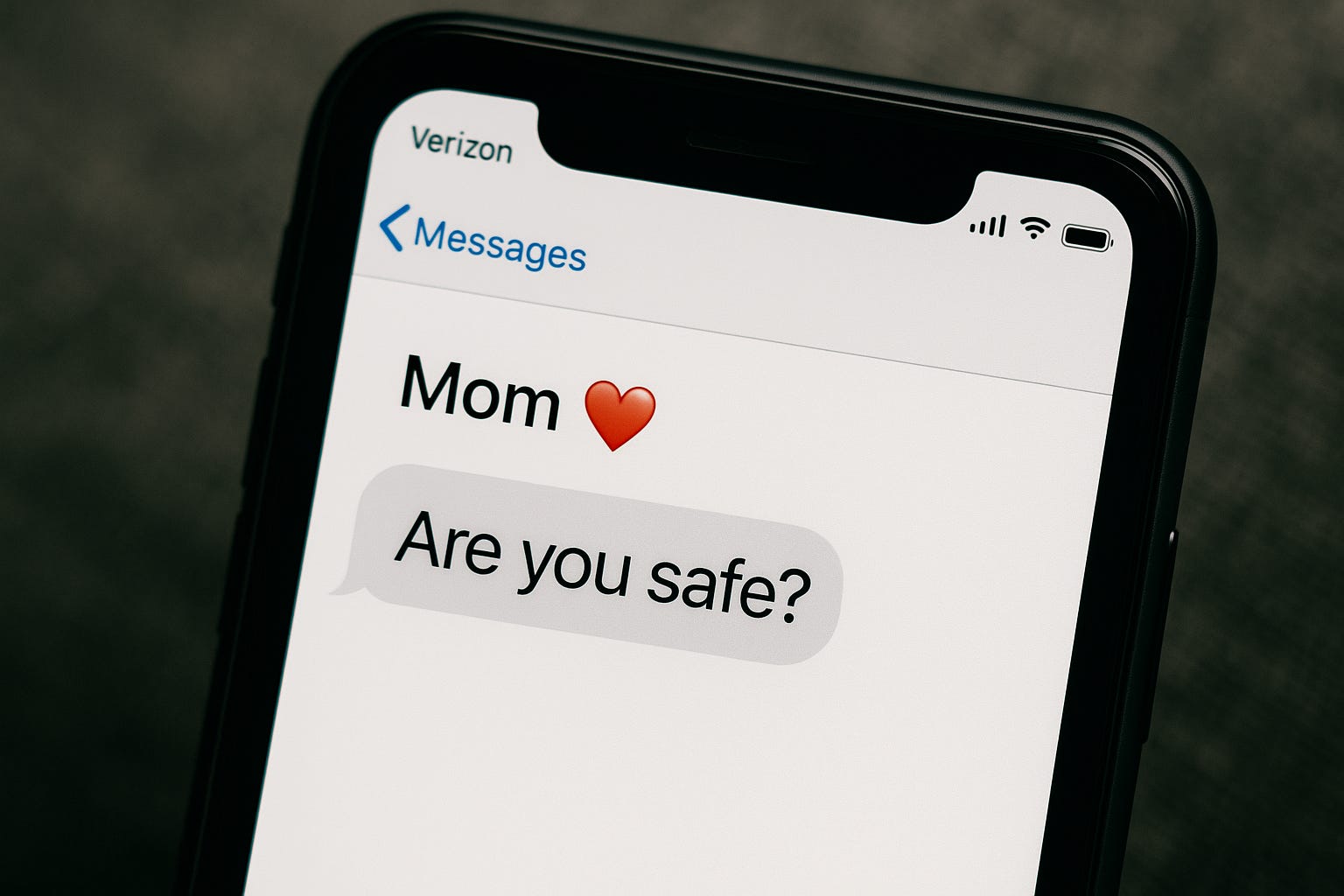
Until we can build schools that parents trust to protect their children — and until we live in a country where school shootings are the rarest of outliers, not a recurring headline — phones will stay in pockets and backpacks. Ideally, not for TikTok or texting, but as potential lifelines.
But if they have them, they will be used for TokTok and texts. They can’t help it. They’re addicted.
And that will continue to undermine even the most thoughtful and well-meaning efforts to remove phones from classrooms. Whether that’s flat-out defiance of the rules — perhaps to precipitate a confrontation with parents, turning in a dummy phone, or being in a teacher’s room who doesn’t believe in the policy — this is a massive weak point in cell phone policies for schools.
And that’s not even counting the phones that low-key sneak onto campus, because otherwise, “nice” parents of the “good” kids don’t trust the school and have come up with plans so they always have a phone on them.
I understand that virtually all policies allow students to access their phones in the case of an emergency, but that keeps them nearby. And we’re back to all the addiction and phone police arguments — will it be turned off? How do teachers know? Are they checking it? Is their watch connected to it, and they’re connected that way? Are they using AI on their phone for less-than-honest reasons? And on and on and on.
I still believe we should try. We owe our students focus, presence, and the chance to be disconnected for a few hours a day. However, we can't discuss phones in schools without also addressing safety. And until we can promise one, we'll continue to lose the other.
Where I’m Landing
I don’t think that locking phones up, bell to bell, may work.
That said, I still believe we can do better.
We can build school cultures where safety isn’t just about what we do in a crisis, but about what we prevent — through trust, connection, and community.
We — those of us charged with enforcing a ban — cannot answer parents' fears with anger. We can have honest conversations with parents and students, not about banning phones, but about creating a healthier relationship with them during the school day. We can earn the confidence that allows parents to slowly let go of the phone as a security blanket.
Perhaps the answer isn’t a hard ban, but a collective step forward: toward boundaries that make room for learning, attention, and presence.
I still believe students deserve that — a space to think, to focus, to just be kids. And I believe we can get there. Not all at once — this work is still going to be hard. But with patience, empathy, and a shared commitment to something better, we can move closer to classrooms where phones — and the fear that keeps them there — no longer need to be part of the picture.
Thanks for reading.
Until Alex Jones blasts their pictures out, claiming they were “crisis actors” and the whole thing was faked. Jesus, what an asshole.
And research that tends to be confirmation bias in a fancy dress.
All true stories.
(sigh) Look — they can’t. SROs can’t. All the “target hardening” and metal detectors can’t. If all of that were going to work, it would’ve worked by now. And all the methods used to date are…problematic, to put it nicely. Just wait until Officer NiceGuy is deputized into ICE…
Or maybe it is — climate change is a thing, and changing our extreme weather. Weather emergencies may become a thing in the coming years.
That’s a super-succinct way to put this.
Even if they have them, and they’re powered off, powering them up takes a minute.
You don't even need a phone for the peace of mind features these parents want. You can buy a smart watch right now that has no internet but has GPS and calls/messaging with a small number of pre-programmed contacts. These do not have nearly the destructive potential of smartphones.
Unfortunately, we live in a society that is immune to facts and data. As a debate coach, I agree that, in an academic debate (typically with parent judges), the "kid needs a cell phone in case of emergency" will trump the facts almost every single time. But here are the facts - schools are among the safest place for children to be (the fear is based on the availability bias - incidents like Parkland and Sandy Hook overshadow the fact that the number of school shootings is infinitesimal compared to the daily damage with distractions and addiction over social media use - but we react emotionally.) Mortality data is well-documented and consistent: the CDC, FBI, and academic researchers all confirm that school-associated violent deaths represent a tiny fraction of child mortality. Drownings and fatal gun deaths outside of schools FAR outnumber child deaths IN schools. But, like almost everything else in our country, you don't convince people with facts.