

The Kids Have AI. The Teachers Have Icebreakers.
Somewhere between the icebreaker and the second bathroom break, teachers will learn about AI for the school year.
I apologize for not keeping to a regular schedule here. Had a hole in my macula and a follow-up vitrectomy. The week spent face-down, allowing the gas bubble in my eye to push the sides of the hole back together, was not enjoyable. Anyway...
Since my words last summer about phone policy adoption were pretty much dead-on prophetic, let’s see if I can do it again this year.
Let me start by saying this — I am pro-AI and appreciate how, with guidance, it can transform education and improve student outcomes, growth, and learning. I use it in my work for school and writing, and I am looking forward to helping students navigate productive relationships with it. AI has the potential to put them light years ahead of where I was at their age. I can get goosebumps at the possibilities it presents for our students.
That said, we’re fumbling the ball over and over again. And we must move faster.
As always, you want to know what it’s like to be a teacher?
Read on…
How The School Year Will Start

Maybe.
Probably.
On one of the early days back to school, the whole staff will gather in a common area and catch up. After someone standing up front attempts to get our attention by saying “clap once if you can hear me,” prompting a gym teacher to whistle, without warning and at a wholly inappropriate volume level, they’ll get a message of greeting, probably followed by an icebreaker1
After the trauma inflicted on us by the icebreaker, it will be time to hear what the district instructed the administration and upcoming presenters to say. Power Points will be read verbatim while teachers text each other, place orders from Amazon, scroll Instagram, or maybe play this year’s PD bingo2.
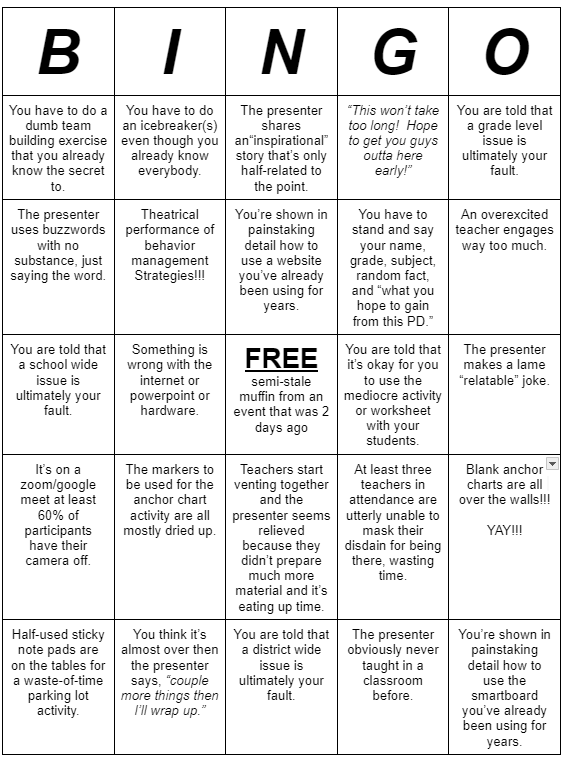
Somewhere, in all of this professional development goodness, the AI guru will show up.
The AI guru will be someone who has attended a couple of workshops, read some articles, and possibly participated in a virtual session, and will be introduced to discuss how the district plans to integrate AI into classrooms starting this year3.
Their slides will feature the worst-ever AI-generated art, likely accompanied by overdone citations to let everyone know they used AI to create the image. Like this:
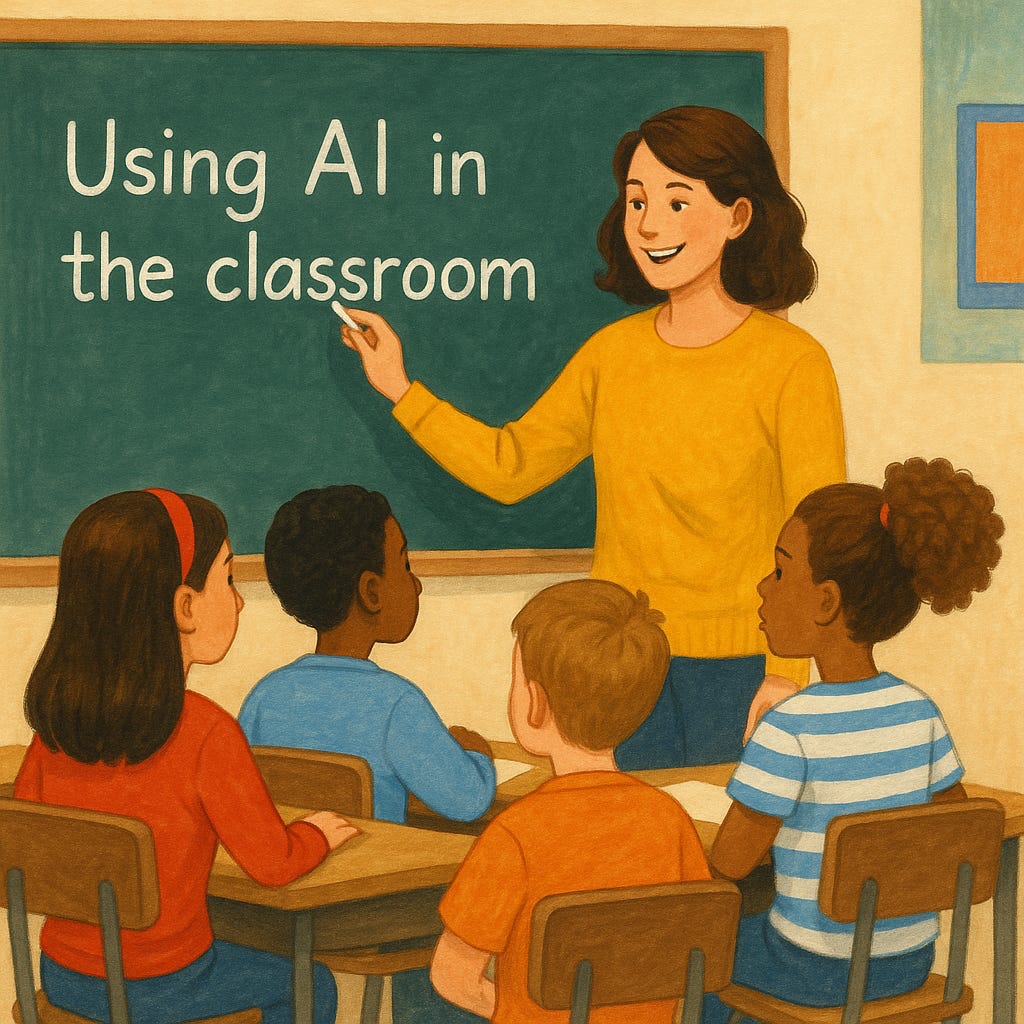
Given that the presentation will have been prepared a couple of weeks in advance, outdated statements will be presented as fact, along with information and claims that are factually untrue4. Slides will be read, and teachers may be assigned to AI-Buddy Groups, as the presenter asked ChatGPT to create randomized groups of five teachers to work on the next ten-page handout5.
It will be spoken about in bland terms as something that is “transformational.” Mentions of “rapidly changing technology” will be made, along with promises of how it will make teachers’ jobs easier. This — this will be the year we lean in and introduce it to kids.
At which point, maybe — hopefully — a cantankerous veteran teacher will interrupt6, growling something like, “The kids are already using it — to cheat!” And they’ll comment on making their room tech-free, or make everything AI-proof. Yeah. As Stephen Fitzpatrick explains (more patiently than I could), AI Proofing is a Myth.
And the PD presenter, if they’ve got a hint of skill, will say something like, “I’m glad you brought that up — this brings me to my next point — how do we get students to understand that what’s important here is the learning7, to see the AI as a collaborative partner in their learning?”
I’m going to try not to dickpunch the strawman I’m arguing against here, but: if we knew how to do that, then we wouldn’t be talking about this in the first place. AI would be another tool in our toolbox, and we’d all roll on. The fact that we have to teach the ethics of a tool is a pretty clear indicator that the idea of students using the tool for warm feelings inside…yeah, that train has left the station.

Pulling the curtain back, this push, this, “we’ve got to get our kids to understand the intrinsic value of learning, and how that outweighs the extrinsic,” works in limited cases, with a subpopulation of a subpopulation of kids. You know the type. They make movies about them.
Again, cup up, strawman. This suggestion is bullshit. As I’ve said before, we, as a society, have beaten the idea that the endpoint (GPA, class standing, college admission, scholarships) is what matters here, and any means are justified in the pursuit of that endpoint. Hell, people at the highest level of power in this country are fucking examples of that.
At the tip of that spear of “endpoint, endpoint, ENDPOINT?” The people who sit in judgment of our schools, our programs, and the effectiveness of teachers. Additionally, they occasionally offer professional development sessions. Maybe even on AI.
And now, that endpoint isn’t the most important thing, it’s all about the journey to get there—the <breathy tone, squeak out a tear from the corner of the eye> formation of lifelong learners <aaaand scene>8.
Sidebar — this “do it for the intrinsic reward” is also expressed to teachers, in terms of the incredibly insulting, “We’re not in this for the income, we’re in it for the outcome9.” Administrative manipulation of faculty is a whole other topic, but phrases like this aren’t “aww, gee” feel-good moments; they, along with things like calling us a “family,” are the death of morale.
Put some emotion into it, get us to stop seeing this as a transactional thing, something that we’d sacrifice our time and health for, willingly, because that’s what families do10. Families sacrifice. My job is a transactional thing. I will thank you not to confuse the two.
Anyway... raw nerve.
The usefulness of the presentation is undermined, but it will continue, with perhaps some practical advice provided. Maybe — and it will probably look like this:
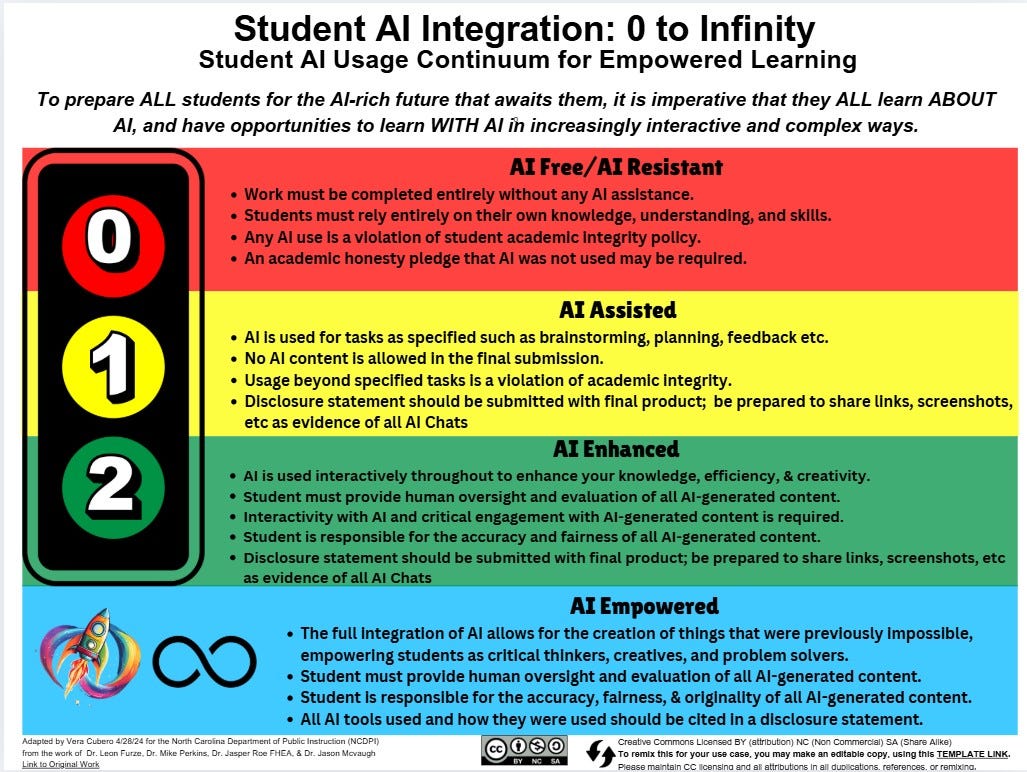
Honestly, this covers the start and middle of what any decent PD about AI in the classroom will be. It’s much better than the earlier days, when AI PD was basically outsourced to AI influencers, edtech insiders, and folks with a vested interest in districts buying their services.
No, Seriously, Is the Teacher v Student AI Divide This Bad?
Yes. Oh, yes.
I mean, I already talked about it — how prevalent it was in my classes this year, once I started looking for it. If I apply the Copernican principle11 to my class incidents and observations, I’m average. There are classes with more, classes with less.
Getting data from public high school students can be tough, so I tend to look at surveys of college and university students as a ballpark. The Chronicle of Higher Education recently did the yeoman’s work of trying to collect surveys about student usage of AI on college campuses.
A survey that reports that 92% of undergrads use AI is eye-opening12. What really stands out is that student use is widespread and its adoption is accelerating. Virtually all surveys of undergraduates show a doubling of student use between 2023 and 2024. What they’re using it for — that’s complicated, with most saying “asking questions” and “writing support.” 25-35% of respondents say they use it for writing entire essays, but my gut13 says that’s an effect of the surveys and interpretive reading of hte question. A strict faculty definition of “cheating” may not be the same yardstick students today are using.
Some report they refuse to use AI for their class work, and while a solid minority (15-25%), that will be shrinking as peer pressure and a lack of detection kick in. It won’t ever be zero, but it will decrease. That lack of detection is a huge thing — an overwhelming 86% of students who say they use AI on assignments were not detected by the professor, assistant, or whatever AI detection tool they may employ.
I showed previously how easy it is for students to cheat on Canvas with AI. If we use the Chronicle’s numbers as an indicator of high school student use, students are in the Mid-Atlantic on the S.S. AI, while schools are thinking that maybe we should get packed and get down to the dock, because that ship’s leaving soon, we hear.
Why Will “OMG - We’re Using AI THIS YEAR!” Happen This Year?
What, that last section wasn’t enough?
Honestly, no.
So why now, why this clunky, and why this…bleh?
A few reasons:
For one, taking baby steps towards adopting a new technology three years after it arrives is pretty much on track for schools. The public school system is uniquely disadvantaged in adapting, changing, or adopting anything, for any number of reasons — money, training, organizational issues14. Example - see “balanced literacy” vs. “the science of reading.” That slow change cost us a generation of readers.
Again, lots of reasons why public schools move achingly slow on these types of things, and I could go into them more, but sooner or later, one of y’all would come over and quietly point out to me that the horse is dead.
There’s also unique pressure now from April’s Executive Order, “Advancing Artificial Intelligence Education for American Youth.” What does it say? Back in April, Nick Potkalitsky broke the Executive Order down, listing the major points, concerns, metrics (or lack thereof), and possible opportunities.
Everyone has read that Executive Order in a slightly different way, and has, or is in the process of hooking their cart to some company’s horse, some guru, or some product, and hoping for the best15. There’s fear at every step that, in trying to make district-wide policy for a technology that changes by the week, someone is going to fuck up and be made an example of, locally or at the Federal level.
Plus, the Department of Education issued guidance on AI in schools in May, with the Secretary of Education, Linda McMahon, adding AI as her fourth priority for the department16:
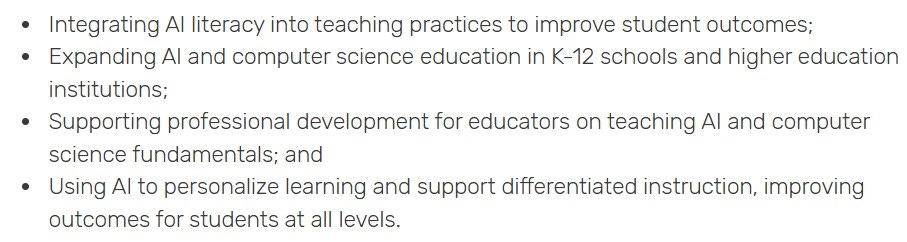
All in all, AI in education has an enormous societal push, a Federal push, and a push from industry, as every AI product maker wants to sell their goods to schools.
Mix this with their persistent position of being behind the eight ball, and schools are trying to catch up, rather than introducing AI to our kids. But catch-up is where we are, and playing catch-up ball is a sloppy, rushed business with an unclear outcome at best.
And…So?
Under no restrictive guidelines, students have embraced AI for over a year and a half now (at least), and have accepted that it will be a part of their world going forward. As early adopters of AI, they’ve found their way in the wilderness, settled on their own ethics for its use, and learned how to apply the technology to their lives and the world around them.
Meanwhile, we’ve piddled, twiddled, and resolved17 for a long time now, and not one damn thing have we solved. The adults send mixed messages about its use, while the few of us who know it are finding our own way, sometimes with amazing results. Neither case is what kids need.

We’re the adults landing on the island at the end of The Lord of the Flies18. After the kids have found their way for an extended period, but now, “We’re here, and we’ve brought civilization with us! Follow our rules! Don’t do that with it, do this! Look at this list of how you can use this thing (that you know more about than me, and I can’t tell if you’re using it in a way I’m telling you not to anyway) and only use it with this list as guidance!” This will play well with anti-authoritarian students. I’m just writing it, and I’m chafing at the idea.
Students need adults who understand AI and can both inform students how to use it, while being comfortable with the gulf of knowledge. They need conversations, not lists. Honest, open conversations about the technology and its use. We have to teach our students how to use it the same way we teach our content: lessons, modeling, answering questions, and providing guidance.
Our kids have grasped and adopted a world-changing technology, and we’ve been largely silent on how they should use it19. And now, it’s time to slowly, achingly slowly start to move forward on how students should use AI and present it in a way that’s going to be presented in a way so it’s “just another thing we need to do” on our list20?
We have to move faster. We have to move better. Big, fearless steps. Our students are depending on us.
Thanks for reading.
Please - I know I have some admins and others who aren’t student-facing who can influence these things. Oh my god, please do not have an icebreaker. Like many teachers, I don’t care what my colleagues’ favorite color is, whether they have a pet, how far they travelled this summer, or….anything. Icebreakers, at best, are infantilizing. At worst, they’re time-wasters. And morale killers. And humiliating. And dumb. And triggering to those of us with August-induced IBS who have to leave for the restroom every year as soon as the icebreakers start up. Let me put it in language that gets you all tingly down there, admins:
Just imagine how much higher scores could be if you got to the meat and potatoes of the training rather than who’s what on a Myers-Briggs test.
If the cards are copied and passed out surreptitiously in time, this year. Looking at you, Ms. K!
No, this is not an old article. Yes, I know ChatGPT showed up in November of 2022,
For the love of god, do not point this out to the presenter. Let them build up their mountain of un- and mistruths as they go. Bigger the balloon, the bigger the pop. I’ve seen PD presenters wrap up 10 minutes into a 45-minute presentation because someone undermined their entire thesis with a well-placed question. Absolute, fucking legend.
Who has that much money to burn on ten-page handouts for every teacher?
Veteran teachers are the worst for interrupting PD teachers who can maybe, sort of remember their four years in the classroom, but honestly, we sniff you out a mile away.
Or some variation of this.
Maybe even with a bonus of a personal anecdote of when, when they were teaching (when a Bush was in the White House), they worked for hours and hours with a student to get them reading at grade level. Well, that student and their daughter stopped them outside the bookstore just last month, thanked them again, and told them they were going in to get a new book for their child. There were hugs and tears all around. Presenters - you do know that when you dust off these stories that just coincidentally illuminate the point you’re trying to make, like 75% of us think you just made it up, right?
Okay, two things here, one — why does the person saying this always make like 2-3 times what the teacher they’re telling it to does; and two — funny story: back in my Angry Years, I had an AP say this to a groupfof us, and I asked if I could have 10% of their paycheck every month. They “up-buh-buhh’d” at me, and I calmly repeated back the income/outcome thing they’d just told us. That AP and me? Lifelong enemies, since. But totally worth it. 10/10, would piss off again.
Look, noob teacher, if leadership at the school you’re looking to work at calls it a “family,” keep your options open.
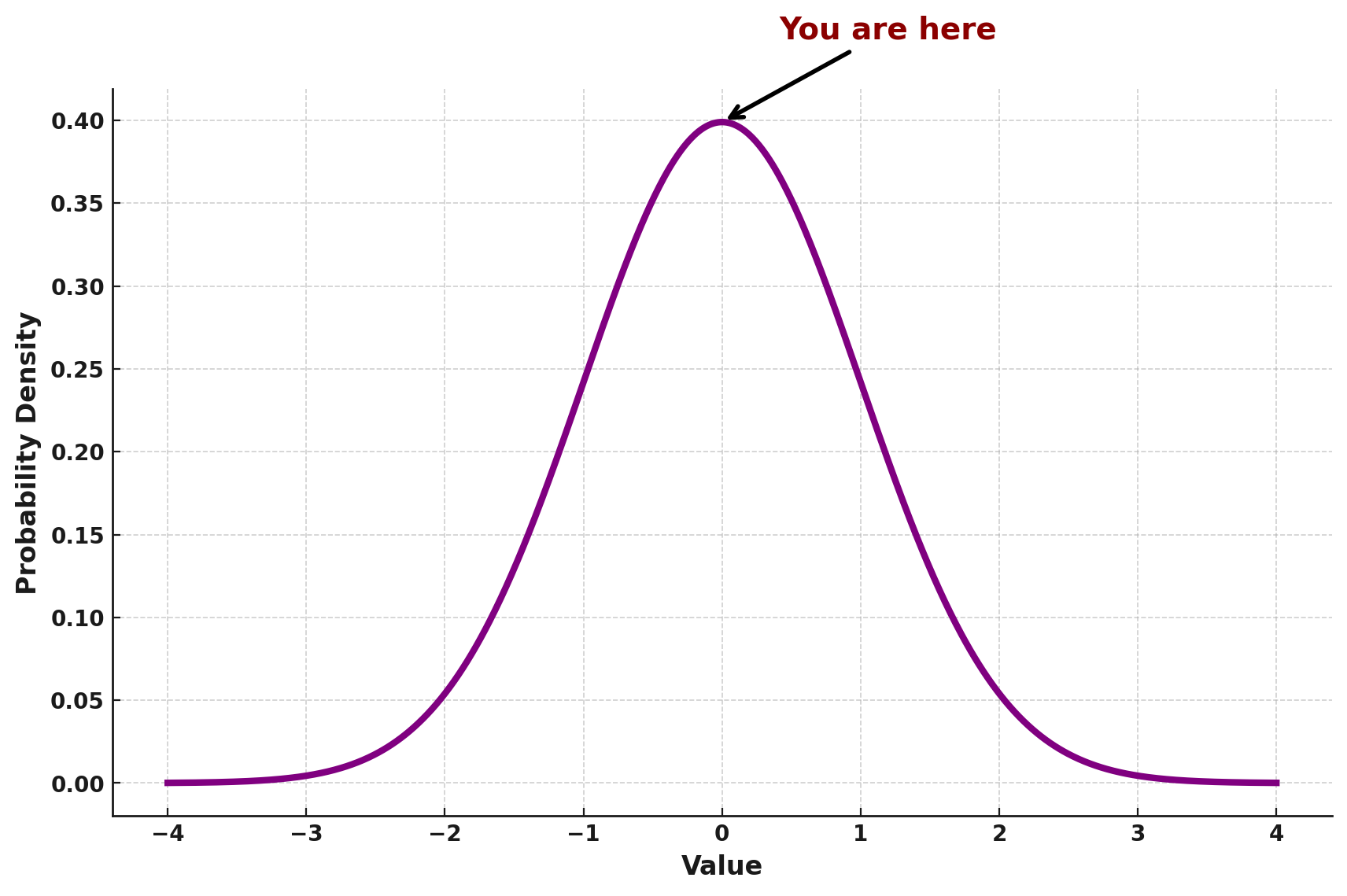
It’s the suggestion that suggests that you and your situation are not exceptional—you are most likely average or typical, unless there's strong evidence to suggest otherwise. In probability terms, this means you're more likely to be in the middle of the distribution than at the extremes. Teacher till I die, yo.
Like this:

My non-scientific gut, not my scientific gut. Even on anonymous surveys, people feel pressure to answer the “right” way, artificially depressing the numbers for the answer options that could get you in trouble, or conflict with your moral compass. And there’s always the paranoia that the “totally anonymous survey” somehow won’t be anonymous at all.
My observations, of course, are mine, for my district in my state. I’m sure other states (probably not in the lower half of the “best schools in the U.S. list”) have already made adoptions and are tweaking and adjusting, rather than running around with hair on fire, while pretending that said hair is not on fire.
“Oh god, our district AI just said that all people should have the same rights, no matter skin color, religion, gender, or political affiliation! Shut it off before our DEI watchdog sees it! Shut it off!”
In its closing days.
I was a musical theater nerd in middle school through to my early years of college.
Science note - in an actual case, a “Lord of the Flies” situation didn’t happen with boys who were stranded on an island. The boys set up a communal way of living that was peaceful. Also, William Golding was a damaged man with serious psychological issues and an asshole.
Or so outdated and old-fashioned to be seen as us yelling at clouds.
I still have key parts of new distrct mandates from 2008 on my “things I have to do list.”
Preaching to the choir ... I laughed out loud re Icebreakers ... Truth to power.