

The 100-Point Scale Is a Design Flaw
Why Failure Shouldn’t Be Final

Last spring, a student looked at his grade, did the math in his head, and said — just loud enough for me to hear — “There’s no point.”
He wasn’t being dramatic. He was being accurate.
That was the moment I stopped treating grading as a moral issue and started treating it like an engineering problem.
In most American schools, grades run from 0 to 100. A rough day might earn a 23%, a 35%, maybe a 58%. If nothing is turned in, the gradebook records a 0.
I use a 50% minimum. No recorded score falls below 50%, whether a student earned 12% or turned in nothing.
That sentence alone is enough to change the temperature in a room.
But once I ran the numbers, the reaction didn’t match the math.
The Structural Distortion We Don’t Talk About
On a 100-point scale, the passing range (60–100) spans 40 points. The failing range (0–59) spans 59.
I tell my students: there are ten points that earn each letter grade above a 60, and fifty-nine that earn an F.
Grades below 50% behave differently from every other grade on the scale. A 95 and an 85 are ten points apart. An 85 and a 75 are ten points apart. But a 60 and a zero are sixty points apart.
The bottom half of the scale isn’t symmetrical with the top.
When we enter a 12% or a 0%, we aren’t just communicating weak mastery. We’re introducing a numerical weight that requires multiple strong performances to offset. The lower half carries disproportionate weight.
A 50% floor doesn’t eliminate failure. It compresses the lower half so it behaves proportionally to the upper half. It makes the scale symmetrical.
That’s a design adjustment — not a lowering of standards.
What a Real Turnaround Looks Like on Paper
Let’s look at a student who starts poorly and then genuinely improves.
Grade Weights
Tests — 50%
Labs — 15%
Project — 20%
Classwork — 15%
Scores
Tests: 35, 42, 92, 96
Labs: 0, 0, 90, 95
Project: 80
Classwork: 0, 0, 0, 0, 0, 85, 85, 85, 85, 85
This is a rough start, followed by real academic improvement.
First, calculate it on a traditional 0–100 scale.
Traditional Grading (0–100 Scale)
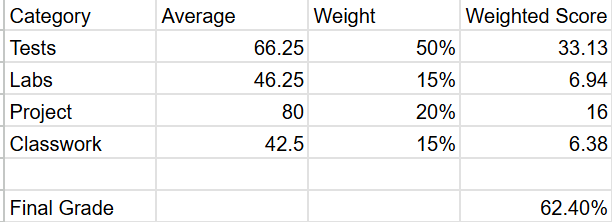
Despite earning 92 and 96 on the final two tests, the overall grade remains in the low 60s. The early zeros dominate the semester average.
Now apply a 50% floor to every score below 50.
Scores
Tests: 35, 42, 92, 96
Labs: 50, 50, 90, 95
Project: 80
Classwork: 50, 50, 50, 50, 50, 85, 85, 85, 85, 85
Minimum Grading (50% Absolute Floor)
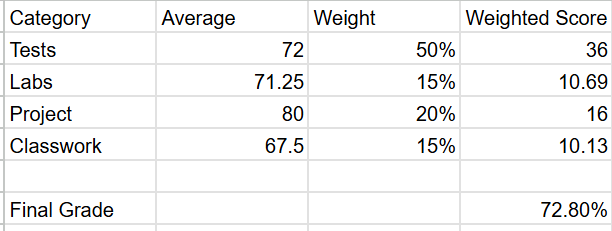
Same student. Same learning at the end. Same mastery demonstrated.
Under the zero scale: 62%.
Under a 50% floor: 72.8%.
The student did not magically earn an A. Standards did not collapse. Early performance still mattered. What changed is that later learning was allowed to move the number.
So I treated grading like a lab.
Hypothesis: If I compress the lower half of the scale, late mastery will move the overall grade proportionally.
Intervention: 50% floor.
Observation: The grade distribution did not inflate. Students who improved saw movement. Students who didn’t, didn’t.
Conclusion: The scale behaved more like a measurement tool than a penalty amplifier.
The Psychological Cost We Pretend Not to See
At some point, this stops being about percentages and becomes about people.
Teenagers are not irrational. They are pragmatic. When they see a grade sink into the 40s because of early zeros, they calculate how many perfect scores it would take to recover. They decide whether the climb is possible.
When the climb looks impossible, many of them stop climbing.
We often say zeros teach responsibility. In practice, I’ve seen them teach futility. When a student believes the semester is mathematically unwinnable, the system has communicated something powerful: your early failure defines you.
A 50% floor does not erase failure. It tells the student something different: you are behind, but you are not buried.
That distinction changes behavior.
The students most harmed by the zero scale are not hypothetical masterminds gaming the system. They start poorly because their lives are unstable. They miss assignments because they are overwhelmed, working, anxious, or distracted by chaos we never see. Sometimes, something shifts. A relationship forms. A tutor helps. They decide to try.
Under a zero scale, that late effort cannot move the grade enough to matter.
Under a 50% floor, it can.
Adolescence is built on second chances — on missteps followed by growth. When a grading system prevents growth from changing the outcome, it quietly tells students that effort is cosmetic.
Hope is not sentimental. It is cognitive fuel. Students work when they believe improvement will count. They disengage when they believe it won’t.
The zero scale can flatten the recovery slope.
A 50% floor restores proportional movement.
What It Did to My Room
I know what this sounds like. After arguing about scale design and weighted averages, I’m about to talk about how my classroom feels.
But classrooms are human systems. If the numbers change behavior, the behavior changes the room.
When I moved to a 50% floor, something shifted. It’s hard to quantify, but unmistakable. The room feels lighter. Not easier. Not softer. Just freer.
The biggest shift wasn’t in the spreadsheet. It was in posture.
Students stopped slumping when they saw an early failure. They started asking, “Okay, what do I need on the next one?”
Recovery became a rational decision instead of a heroic one.
Students still panic about low grades. They still come in upset when they see a 62 or a 58. They understand that stacking multiple 50s and low 60s creates real gravity in their average, and that climbing out takes sustained effort. They still cry sometimes when a test comes back lower than they expected.
Nothing about the academic expectations has changed.
What has disappeared is the sense that one bad stretch permanently defines the semester. I no longer have students who simply decide they’re “that” student, and nothing can change it.
Students work. They revise. They retake. They calculate. They come for help. They know recovery is possible, which makes the effort rational.
My grade distribution has not transformed into a utopia of effortless As. There has been no explosion of top scores. The curve looks remarkably normal. The difference isn’t inflation.
The difference is that students know I care about whether they ultimately learn the material — not about whether I can mathematically punish them for stumbling early.
I have to explain that not all of their classes operate this way, and that some teachers still use the traditional zero scale. The conversation is awkward. It’s also revealing. Students immediately understand the distinction. They feel it.
What they sense — and what I sense — is that the grading system is aligned with growth instead of finality.
The room is not more permissive.
It is more hopeful.
Hope, in a classroom, changes behavior more reliably than fear ever has.
The Myth of the Strategic Slacker
At this point, someone insists students will exploit this — that they’ll collect 50s and do just enough to pass.
I understand the concern about the “strategic slacker.” In my experience, that student is theoretical — someone who does minimal work, but is a math genius at the same time.
Students disengaged enough to do nothing for weeks are not secretly calculating weighted averages or engineering semester-long strategies. If they had that level of foresight and discipline, they wouldn’t be disengaged.
Even under a 50% floor, passing requires real work. A student earning nothing but 50s still fails. Mastery of major assessments is required to climb.
What minimum grading removes is not accountability. It removes mathematical annihilation.
“But What About the Kid Who Earned a 56?”
One objection deserves a serious answer: how is it fair that a student who tries and earns a 56% sits in the same numerical neighborhood as a student who does nothing and receives a 50%?
First, they are not the same. A 56% is still higher than a 50%, and in a weighted system those differences accumulate.
But the deeper question is this: what is a grade supposed to represent?
A grade is meant to communicate mastery of content. A 56% indicates limited mastery. A 50% floor indicates that mastery has not yet been demonstrated. Both fall below proficiency. The distinction is real, but not enormous.
Under a traditional scale, the gap between 56% and 0 is 56 points. The gap between 86% and 100% is 14. That imbalance reveals the problem: the lower half carries disproportionate weight.
Minimum grading does not erase the difference between weak work and missing work. It removes the structural overreaction built into the lower half. It prevents one form of failure from becoming permanent mathematical debt.
If fairness is the concern, we should also ask whether it is fair for one early collapse to outweigh weeks of later improvement. The 50% floor keeps distinctions intact while restoring proportionality.
Grades should measure learning — not amplify punishment.
What This Debate Is Actually About
A zero does not measure what a student knows. It measures how severely we respond to what they didn’t do.
If a student earns a 35 because they did not understand the material, that reflects mastery. If they submit weak work and earn a 42, that also reflects mastery.
When we assign a zero, we are not increasing precision. We are increasing severity.
If the numerical impact of zeros is often modest in weighted systems, the debate may not be about precision at all. It may be about what we believe grades are for.
Punishment feels powerful.
Power is not the same thing as rigor.
The Question We Have to Answer
Not doing the work should cost you that assignment. It should lower your average. It should prompt intervention.
What it should not do is mathematically erase the impact of later mastery.
If grades are meant to communicate what a student ultimately knows and can do, the scale must allow growth to change the outcome.
That’s all this is for me — not a revolution, not a manifesto. A design adjustment so that growth counts.
Once I saw the math — and the students behind the math — I couldn’t unsee the distortion. So I adjusted the system in my room.
Minimum grading does not excuse failure. It recalibrates the scale so that failure is proportional and recovery is possible.
The numbers show the distortion. The psychology shows the cost.
The rest is a choice.
Do we want a grading system that measures learning?
Or one that amplifies collapse?
Once you see the math — and the kids behind it — it becomes difficult to pretend those are the same thing.
I teach college. I get what you’re saying but I just can’t bring myself to give a 50% for literally nothing. That sends a message, and the message (merited or not) is “I am prepared to bend ALL the way over”.
You’re distorting your numerical grade assignments to compensate for the top heaviness of the corresponding letter grade system. There are other ways to do this. My methods:
1. Drop the lowest test grade
2. Allow students to reattempt an assignment and earn up to 50% of their missed points back
3. Carefully structured extra credit opportunities embedded throughout the semester
Dropping the lowest grade takes care of the student who just didn’t know what to expect on their first test and didn’t study hard enough or studied the wrong way. It gives them a chance to adjust. It also gives a safety net for when life gets in the way (sick kid, sick self, bad breakup, etc.)
Allowing students to earn back 50% of missed points is a progressive reward system. Benefit to a student with a 98%: 1%. Benefit to a student with a 50%: 25%. The incentive also increases the chance that they will master the foundational skills so they don’t flounder more and more as the semester goes on.
Well structured extra credit: I tell them about it in advance. I also tell them it’s the only extra credit on offer: they have to choose to do the assignment at the time it is due. There will be no hastily made up assignments at the end of the semester to rescue their grade. The extra credit tends to be things that are time consuming, so they cost some effort. For example: participate in an optional “flash card audit” where I randomly select a subset of vocab words and check your flash card deck for them at set points during the semester. You may have to make 200 cards and I only have to grade 10 of them. Or create a video project illustrating some concept - here’s the rubric and it’s on you to figure out the technical details. I can assign work students would otherwise balk at because it’s extra credit and you don’t HAVE to do it.
At present, I’m offering extra credit opportunities totaling about 12% of the final grade. I’m also running an optional jeopardy game online where students can prospectively compete for extra credit toward their final exam. Allows students with test anxiety or who just want to build a hedge against a possible bad day to breathe a little easier.
These are just a few ideas. There are so many ways to rescue the bottom students without making it a handout for nothing.
By the way, I have one of those mastermind students that you say you never see. He earns 90% for half the class. Then, as soon as he is mathematically certain he’s got enough to pass the class, he starts to coast - suddenly he’s getting 50% or worse on every exam. Just wants a degree. Doesn’t give a damn about his GPA. Honestly, I kind of respect it. But I’m not going to make it easier by giving him 50% for not even showing up to the exam.
So when my school imposed 50% minimums for every assignment, students soon figured out that they could skip many assignments - maybe do 1/3 or 1/4. Because they would still pass! (Do the math.) It’s not like most teachers gave kids 10% or 30% scores anyway; usually crappy work would merit a 50 or 60. And if someone earns a 25% on a test…that is valuable info - not saying you have to keep that score. Zeroes let parents know that the kid turned in NOTHING. Not bad work, nothing.