

Day 1: Make the Gunpowder
Don’t explain the class. Start it.
Did I ever mention that my wife used to teach science, too? She made it 16 years. Then all it took was one Really Bad Meeting with a Really Bad Principal, and she leaped at an opportunity that had opened up that very day, coincidentally. The universe, apparently, had been listening. She’s much happier now.
Prior to that, we taught at the same school and, for a few years, finally ended up across the hall from each other. We were good teachers. Really good. And together, working with the IB curriculum, we were a hell of a team. We jokingly set up a hierarchy of why we were secure in our jobs:
we had good scores
we always had killer lesson plans
we were presenting, within the district, regionally, and nationally
we developed terrific activities that engaged the kids
we were known in the community as science teachers
and at the bottom of the list was this one:
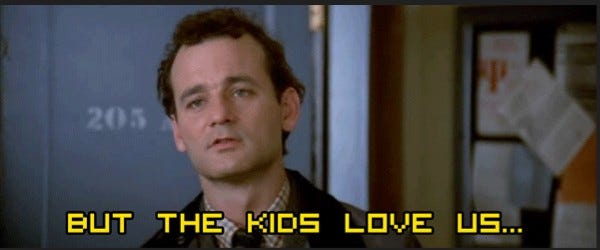
If the reference zipped by too quickly, it’s from Ghostbusters (1984). Dean Yeager has arrived to tell Venkman, Spengler, and Stantz that Columbia has terminated their grant and wants them out. Venkman’s defense for keeping them around: “But the kids love us.”
My wife and I saw that as the weakest argument on the list. The scores, the lesson plans, the professional recognition, the hoop-jumping—that was the stuff that mattered.
Holy shit, was I wrong about that.
I’ve said it before: I will never be a Teacher of the Year.
I never met a rule I didn’t side-eye; I have zero desire to be an administrator; my in-class jokes aren’t always district-approved, and I never mastered coloring in the lines. I’m so anti-authority, I disagree with many of my own decisions on a near-constant basis.
That said, after 16 years in the job, I do know what I’m doing. Whether or not you want to listen to me is up to you.
Day one of a new semester?
Make the goddamn gunpowder.
Literal Gunpowder? In My Class, Yes.
I teach chemistry and physics, so this will lean towards the science side, but the larger idea in here is not exclusive to science.
So yes, I literally make gunpowder on the first day of a new semester. My flow goes like this (we have 90-minute periods): a super-quick attendance check, a “getting to know you” page, a quick run-through of where everything lives on Canvas (we still attach them to devices like mind-sucking Cronenberg cords), a quick intro to what chemistry is, and then the activity: making a reactive mixture.
That mixture is gunpowder.
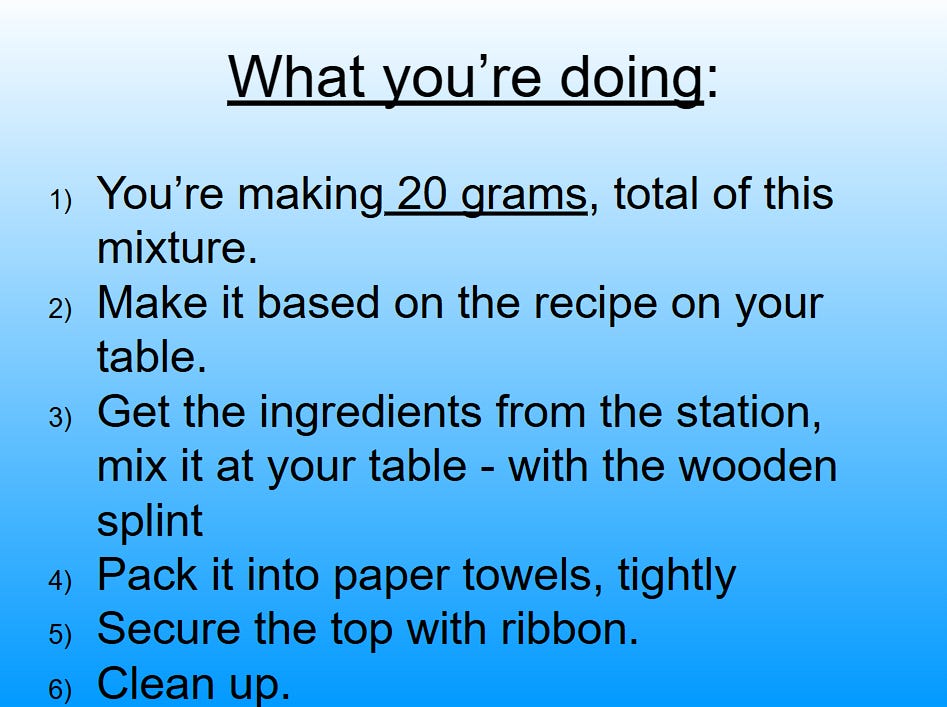
My documented, administrator-friendly rationale is that this one activity introduces elements, compounds, reactions, calculations, measurement, reactants and products, careful observation, and appropriate lab safety.
It’s a taste of the entire course in less than one period.
Yes, I do keep them safe. They wear goggles and follow the appropriate lab safety rules as they work (using only wood and plastic to reduce the risk of accidental sparks from static buildup). Have I run them through the “safety in lab” presentation? No. Have they signed the (unenforceable) Safety Contracts? Also no. Do I tell them that I trust them to be safe? Yes.
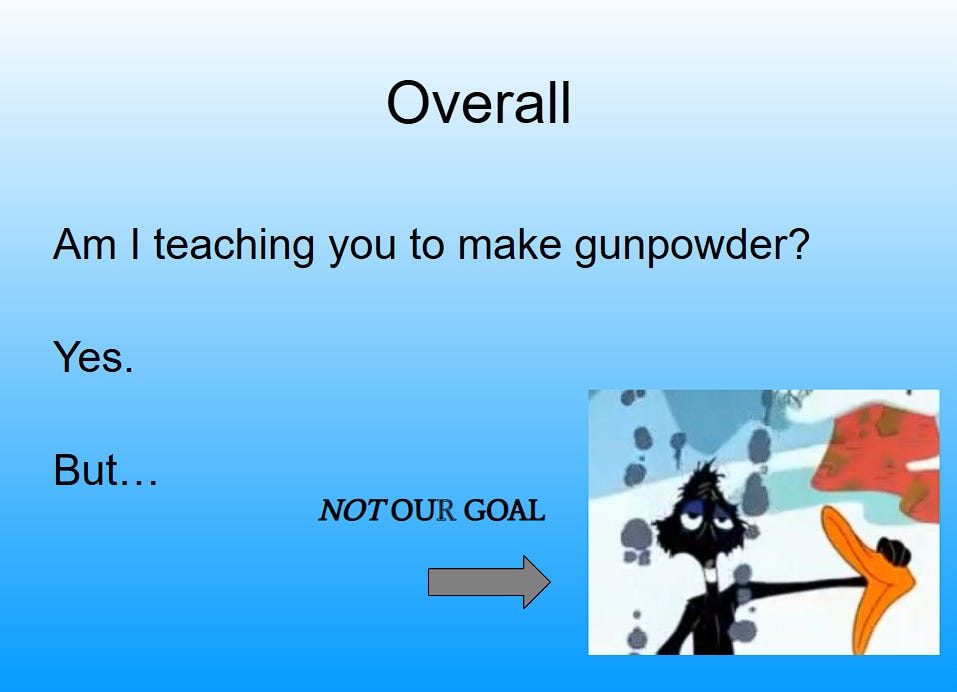
Do I trust them to be safe? Yes.
Also - I’m the “no phones in class guy,” but that rule starts being enforced tomorrow. For today, they’re welcome to take pictures, film, and otherwise document the activity. I know some of it will get out on social media. I’m fine with that. There are other days when I deliberately open the same window.
Marketing.
We put the ingredients together, stir the mixture, and package it in paper towels tied with ribbons. I point out that these resemble the rudimentary cartridges hunters and soldiers used in their rifles a few hundred years ago. Cross-disciplinary learning! Once everyone is finished, we go outside and light them off.
For absolute clarity, we go outside, and I light them off. I am older, more experienced, and have more insurance than they do. They stand at least ten feet back from where I’m lighting them on fire. I also tell them to move if the smoke blows their way, because it smells unpleasant.
Again, in the spirit of clarity, these are little pods of gunpowder, wrapped in paper towels. Under these conditions, they burn; they do not explode. The term we use in class is “fffft,” which comes from the Greek for “a lot of smoke and flames, but no kaboom.” They note that the smoke smells strongly of fireworks.
We don’t do this as just a thing. They need to produce an Explainer (I’ll explain what those are in detail in a later piece) in the week using text and graphics to show what they did, what happened, and why. They also answer two follow-up questions whose answers were hiding in plain sight during the activity.
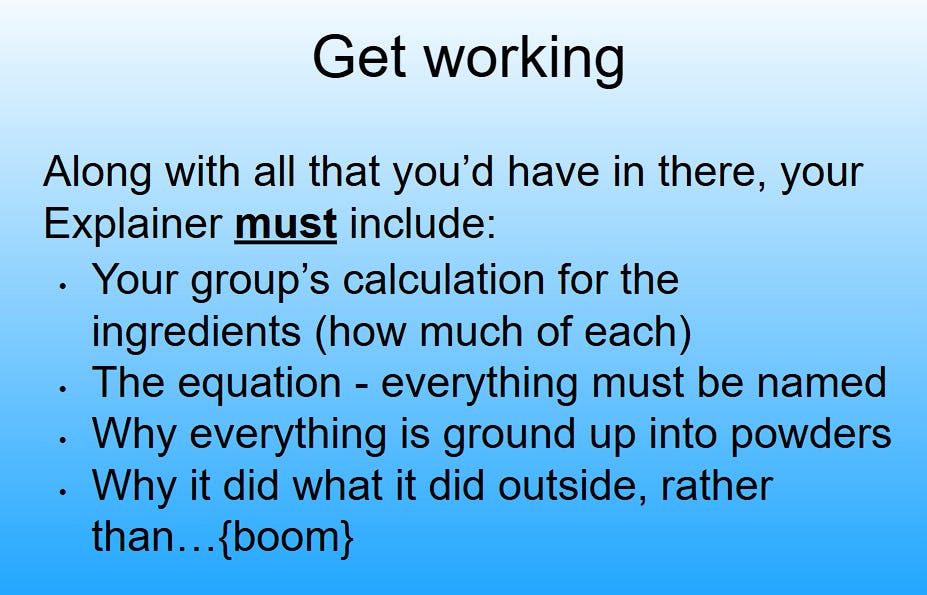
And that’s the first day. We made gunpowder.
It’s not a secret, either. I tell students and parents at open house. My administration knows that the other chemistry teacher and I do this on the first day. I call the front office before we head outside, so nobody has to worry about the smell of sulfur. No one has ever been injured; I make sure we light off all the gunpowder that we make, and it’s much safer than the pearl-clutching grandmother currently shouting inside your head thinks it is.
Oh, and by the end of that first period? Those kids are mine.
I mean that, and I mean no offense to the people I work with. But in my class, we went from zero to 60 in less than a period. I tell them that not every day will involve fire. This is disappointing but true. Still, I send them home with an experience.
Physics is less explosive—usually—but we’re still out of the room, in the front hall measuring walking speed, building and defending a mathematical model, while quietly front-loading the coming week.
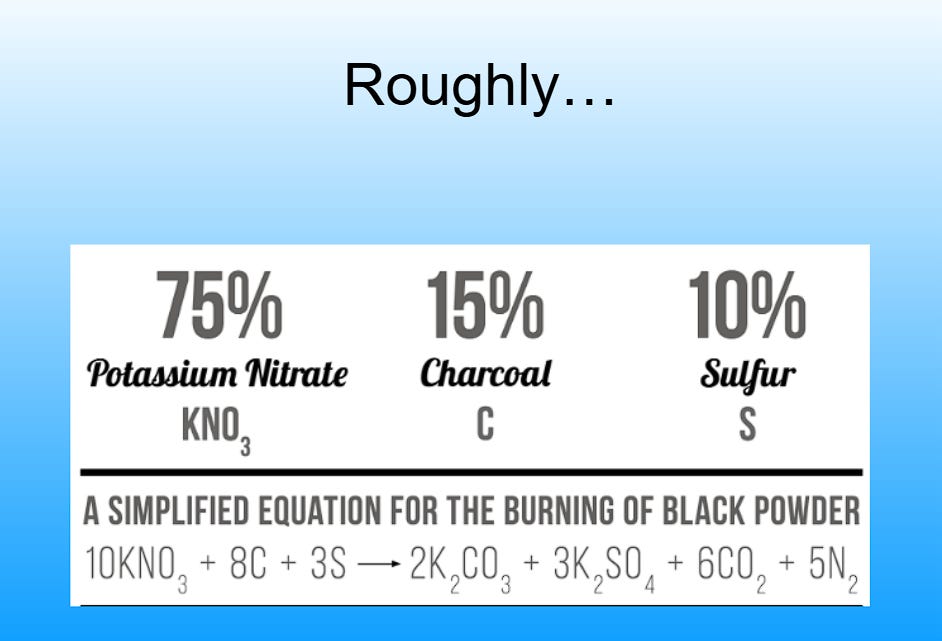
Side note: This first-day reaction comes up again and again. When we get to flame tests (different metals, different colors), their assignment is to design a country-themed fireworks show for one of the nations represented in EPCOT’s World Showcase. They diagram the shells, choose the colors, and explain what the gunpowder is doing inside each one.
When we reach balancing equations, I give them the word reaction, and they have to balance it.
When stoichiometry comes up, they have to tell me how many grams or liters of carbon dioxide (or whatever reactant or product I choose to ask about) were used or produced during the burning of their 20 grams of gunpowder.
If I time it right, I can complete the circle and have it be the last question on the last in-class test for the course. It’s the gift that keeps on giving.
Reflections and Refinement
Making gunpowder used to be an end-of-course activity, not a first-day thing. I used to save the good stuff for last. Eventually, I realized there was a much better time for it.
I’ve heard the concerns and worries from other science teachers, and, as with any activity we do with students, this gets reviewed and refined every year. No, I’m not being reckless. It’s safe, and it has value.
Even after all that review and refinement, one question keeps returning: “Am I really doing the right thing on the first day?”
I find that the longer I teach, the more questions I have about whether I’m doing any of this right.
I’ve also learned that that’s a feature, not a bug.
Christ, 16 years in, and I cannot imagine ever feeling that I really know what I’m doing. There’s a lot of this I’m still making up as I go along.
That question about the activity’s “rightness” gets answered every time we walk outside to light off that handmade, artisanal gunpowder. We walk by rooms of students with desks in rows, facing a screen and looking vaguely like this:
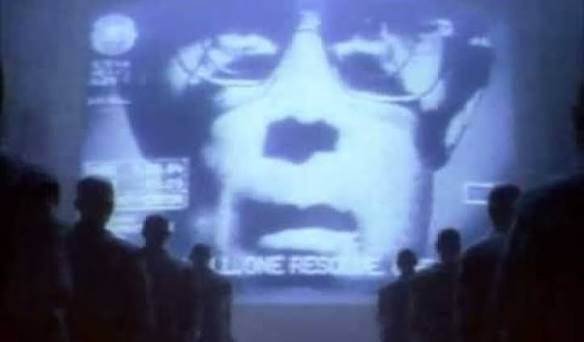
Other rooms are going over the syllabus, the schedule, pacing, expectations, all the mind-numbing stuff that we’ve trained kids to expect from the first day of a new semester. Sometimes they have their overhead lights off. Hell, I’ve even heard some teachers say, “Okay, so this is the boring stuff.” I get sleepy walking by those rooms.
Yeah, I'm going to keep making the gunpowder.
“Must Be Nice to Teach About Stuff that Blows Up…”
That’s a paraphrase of what someone said during a PD I gave on this sort of classroom experience—or what we call “engagement” when adults are in the room.
It was a social studies teacher, implying that because I have the chemistry and physics stuff, I can “gee whiz” my kids more easily than they can.
Guys.
Guys.
The gunpowder is literal in my room. Everywhere else, it’s a metaphor.
We got that, right?
I once attended a PD where Steve Spangler said something that has been rattling around in my head ever since. Steve said that if he were still in the classroom, he would see himself in competition with every other teacher in the building. He wanted to teach the class that gets mentioned first when an adult asks, “So what did you do in school today?” Maybe that question comes in the car, at the dinner table, or during a quick Chick-fil-A stop before practice. It still counts. If his class is the first one that’s mentioned, then he knows he made an impact; he related.
I repeated that idea during my own PD. Hence the response.
But…social studies? Seriously?
You’re telling me there’s nothing in social studies that compares to my gunpowder in the year of our Lord, two thousand and twenty-six? Nothing you can put in front of students on the very first day about history, civics, voting, economics, politics…nothing that can be folded into a lesson that pulls them completely into the room?
(The bold and italicized “nothing” above was to imply my incredulousness.)
Same goes for English, Art, Maths, or anything. What’s going to engage those kids? Don’t know? You’ve got a couple of weeks. Find out what world they already live in. Find out what they authentically care about (not what the adults think they care about). Find the questions they have that scare them. Remind them, by example, that one of the surest ways to shrink fear is to learn as much as you can about the thing.
What can students actually do on day one that makes your subject feel necessary, alive, strange, useful, dangerous, beautiful, or worth knowing?
Don’t make my gunpowder. Find yours.
Don’t think you have any, or nothing like this exists for your subject area? My brothers and sisters in education, and I say this with all respect and love, what the fuck are you doing as a teacher? Warming a room with your body heat? Putting in the time until that admin job opens up? Running down the retirement clock?
Come the fuck on.
The First Day Is a Promise
Most first days tell students about the class they’re starting. I want mine to experience it immediately. No waiting.
Most of us begin with the same pile of first-day obligations, and I’ve watched teachers work through all of them: a syllabus describes the course, a rules presentation regulates the course (and students), and an icebreaker delays the course.
But the right activity is the course.
Side note: There is a danger to swinging for the fences on day one. You’ll see the engagement in your students—the interest on their faces. You’ll hear valuable conversations happening on the very first day. And then you’ll realize: this is what they now expect from your class.
Yeah, oh shit. (I write that with a smile on my face, since emojis are tres gauche.)
Making the gunpowder is a blessing and a curse. I mean, it’s a good curse, but it’s still a curse. You’re going to have to follow through on the promise you just made without saying a word.
I’m not saying that the boring machinery doesn’t have to happen. Canvas will still need to be explained, rules will still exist, and safety still matters. But none of it has to be the first and most memorable thing students learn about the class—or about me.
The syllabus will still be there tomorrow. The first day will not.
The first day of class should be a promise. A thesis statement of what is to come. Not an administrative holding area. It should answer the question students are already carrying into the room: What happens here?
And this is where the first-day question becomes a question of teacher autonomy.
I love the phrase “No one is coming. It is up to us.” It has been on a sticker in my room since our run of “education” during COVID proved it right. If anything, that was my lesson from COVID - no one above me in the organizational hierarchy knows my students, my classroom, my subject, or how to teach it better than I do. Your mileage may vary. Mine did not.

I applied that lesson to the rest of my practice and finally recognized the truth I wish I’d understood around year four: Nobody is going to authorize you to become the teacher you want to be.
The system will happily provide:
a syllabus template,
a slide deck on expectations,
a district-approved icebreaker,
a pacing guide,
a safety contract,
a twelve-step program for teaching by compliance,
and forty-seven other things students have to sign.
It will not hand you a meaningful first day.
That requires judgment. Not rule-breaking for its own sake, or recklessness, but the professional judgment to say, “I know these students, I know this subject, and I know what my students should experience on day one.”
One important qualification to Steve Spangler’s idea: the point is not to just be the first class mentioned. Anyone can do that with spectacle, chaos, humiliation, or candy. The real question is what your students will say when someone asks, “What did you do in class today?” Then ask what their answer tells them about the semester or year ahead.
“We went over the syllabus” communicates something.
“We made gunpowder and then had to explain why it worked” communicates something else. If it works, they leave thinking, “This teacher knows where we’re going. I might want to go with them.”
If that happens, those kids are, as I said, mine. But in giving them that day one experience, they know something else—for that period, I am theirs. Maybe that was what my wife and I got wrong about our hierarchy. “But the kids love us” was never beneath the real work. It was evidence that the real work had reached them.
Dean Yeager and the institution may not understand or reward that, but it’s still the work.
Find your gunpowder.
Then make the goddamn gunpowder.
We just got the vague details of the “videos & slides”!they want us to show on day one, period by period. I’m 27 years in and I totally agree with you on this. The first day sets the tone for the whole school, and when this “damage” is done on the first day in each class and period, we have lost them.
What a great challenge to all teachers......MAKE THE GUNPOWDER, for “This teacher knows where we’re going. I might want to go with them" could be the best doorway back into learning possible!! I love every part of this article and this idea. Your voice and tone make me want to always read here. Thank you for writing.