
AI: The Trust-Breaker
What happens to a community when authorship becomes unknowable?
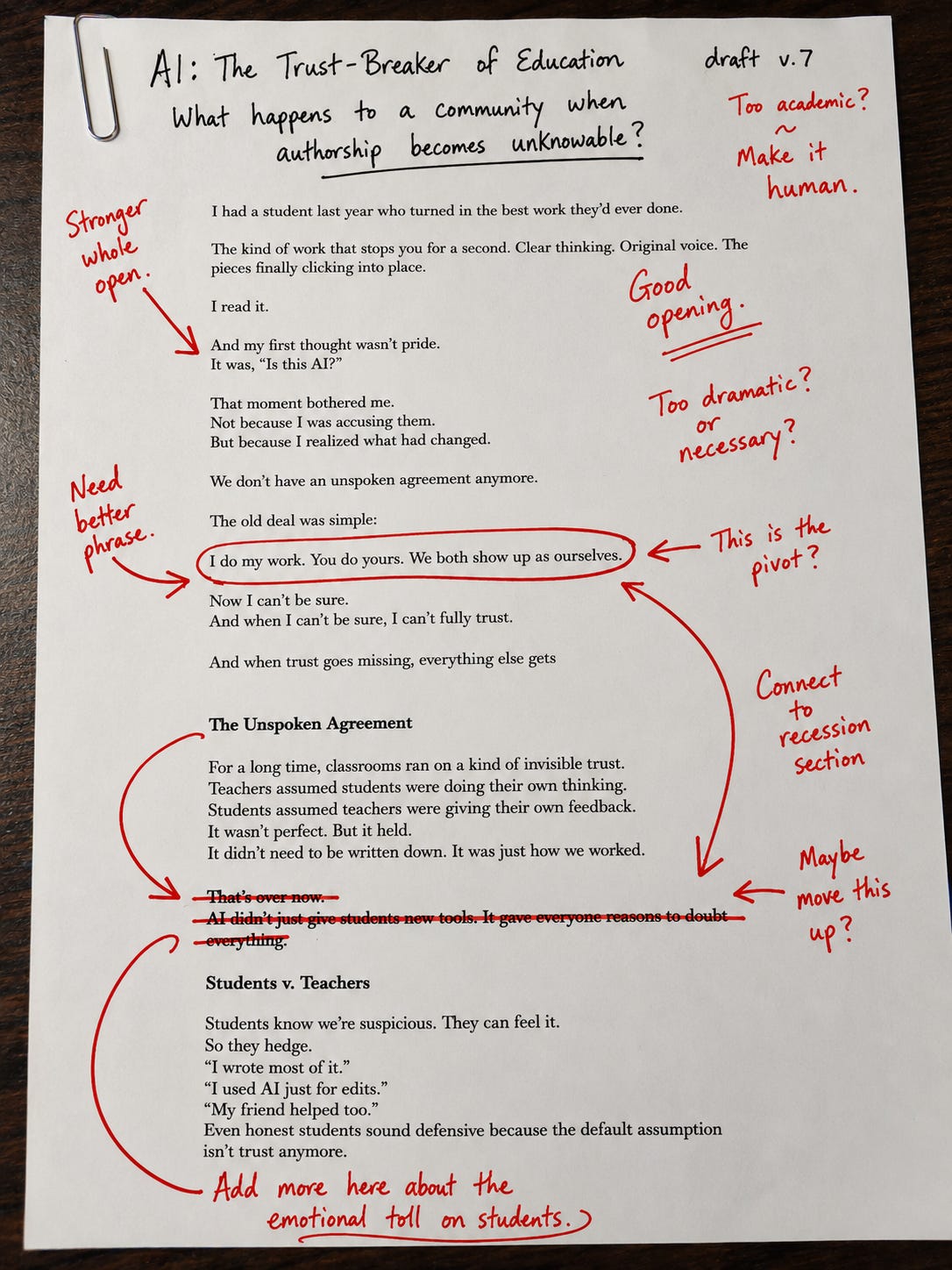
You got a shorter one last time. This time, I’m taking my time to wander through this idea.
Geneology
This is as good a place as any to start. The idea for this piece began this past spring, specifically at the end of the school year, when our superintendent sent out a “personal message of thanks” to staff, buried in the weekly district emailer.
Something about the tone felt…weird to me. So I put it into the hot new AI detector at the time (Pangram), and it flagged the message as 100% AI-generated. I ran it through about half a dozen others. Many said 100% AI; none put it below 85% AI, maybe with a little human glazing on top. Reports from AI detectors aren’t absolute proof, of course. That’s going to become important.
I pointed this out to a couple of friends, and…well, it was May. We were “teacher tired.” No one cared all that much or, revealingly, expected anything less.
I think that last part was fueled by a year of AI-generated or AI-polished emails from school and district leadership, some barely noticeable as you read them, others glaringly so.
And the content that came from the top and colleagues…oof. AI-generated imagery, slides, fliers, and dozens of versions of our beloved mascot (a camel…there’s a whole story about that), all created with, let’s say, heavy AI assistance. Or, less charitably, AI slop.
I just swallowed it as part of the “brave” new world we were entering with AI and filed it away. It was a year.
Then, recently, Stephen Fitzpatrick’s piece pointed me to the Brookings Institute’s Center for Universal Education report from January on AI and education (it’s the one that says the risks currently s outweigh the promises). I hadn’t seen it, so I dug in: reading the study, listening to the podcast, and watching the authors break it down with Kara Swisher.
Somewhere in all of that, the idea of AI’s effect on trust in the classroom came up. Not that we should trust AI — we shouldn’t. It’s not 100% correct. To clarify, what was being discussed was trust among humans in an environment where AI is being used regularly.
That stuck with me because, like a lot of teachers, I was now looking at my students’ work through a lens of suspicion.
I thought I had AI-proofed my assignments, or at least made them so that using AI would be more onerous for students than just doing the work themselves. There was work this year that came in good…no, great from students I hadn’t expected to show that kind of insight or put all the pieces together. But there it was. They had. More and more, I didn’t feel proud; I felt suspicious. I couldn’t prove anything. I just had an itch, and I wasn’t fully trusting them anymore.
And it was coming from the other side as well. Full disclosure: I use AI for work. Most often, I use it to stress-test assignments, clarify my thinking, check questions against Bloom’s taxonomy and Depth of Knowledge, or proofread for grammar. Occasionally, I’ll use it to help me design a problem or scenario. As I’ve mentioned before, I used it to design ridiculous movie posters and ride posters at Bad Idea Park, and my students were in on the joke that the material was AI-generated. Horribly so.
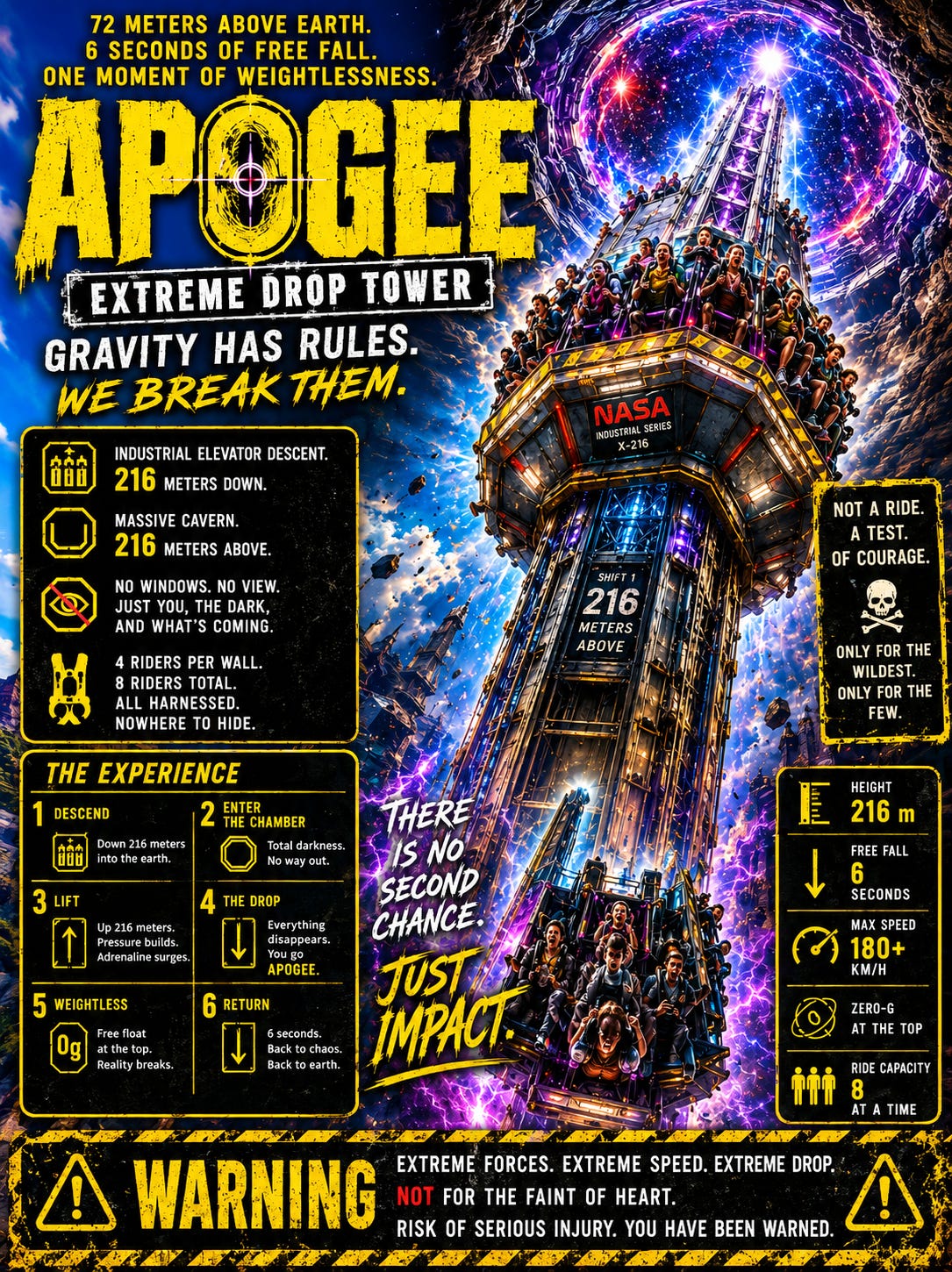
About midway through the year, my students started peppering me with “Is this AI?” questions about the assignments I gave them. Sometimes, they’d caught one of the AI-assisted pieces I hadn’t proofread closely enough. Sometimes, yes, they were playing along with the bit when something was obviously AI. But often, no. The thing they were asking about wasn’t AI-generated or AI-assisted at all.
My students were looking at what I was giving them through a lens of suspicion.
And many times, when they asked, I felt a twinge of guilt or annoyance, even about things that were 100% “me” generated. My students didn’t trust me.
Pile all of that together, and I think there’s a problem with AI in schools that we’ve barely begun to talk about: AI breaks trust.
It’s not because everyone is cheating or swapping in AI slop for their own work.
It’s because everyone might be.
The Unspoken Agreement
A school or an entire district is an absurdly trust-dependent institution. We trust that students are putting forth the effort and have attempted the work themselves. Students trust that teachers read their work and that any feedback comes from careful reading and analysis.
Parents trust that teachers know their children and that any communication is personal, based on observation, experience, and actual knowledge of the child. Administrators and leadership rely on us to use our professional judgment. Teachers trust leadership to work toward what is best for students and to mean what they say.
The organization depends on everyone else being open and honest. That’s trust.
That doesn’t make schools different or special. It’s just how they run.
I know teachers are reading this who are rolling their eyes. No, it has never been perfect. But trust was still the foundation. You expected that the human being standing in front of you or communicating with you had actually taken part in the interaction.
AI breaks that assumption.
We have spent, and continue to spend, huge amounts of time discussing the quality of AI-generated work. Is it good enough? Is it a genuine synthesis of human and machine thinking?
We haven’t spent nearly enough time asking what happens when nobody knows who did the work, or what that uncertainty does to an endeavor built on trust.
And yes, I know, people violated that trust long before AI. Students cheated. Teachers phoned things in. Administrators sent canned messages and broke beginning-of-the-year promises. But now, with almost every piece of work or communication, there is a reasonable possibility that the person on the other end didn’t actually do it.
Yeah, that’s new.
Teachers v. Students
I’m going ot sound a little cynical here.
Everyone has written about how students use AI to cheat. I wrote about it. I performed my required righteous indignation and teacher fury.
But that’s not the thing here. The thing is what the suspicion that “everyone uses AI to cheat” does to the innocent student.
Okay, I know. Not every teacher thinks this about every student. We’re imagining a tendency here. Work with me.
What does the accusation, or even the mild question of AI use on an assignment, do to a kid who has suddenly found their voice, gotten some help from a parent, or worked harder because maybe, just maybe, they took something the teacher said about hard work to heart?
Now, that kid’s effort - the polished sentence, the well-constructed essay, the explanation of a scientific process isn’t a reason to celebrate. It’s evidence. A student can do everything right and still be seen as a suspect rather than a success.
And when teachers start reading for evidence of fraud rather than evidence of thought, the ground beneath the relationship has shifted.
And this doesn’t end with the assignment.
What happens to a young writer, a young scientist, a young leader when improvement itself becomes suspicious?
Students v. Teachers
Students know teachers have access to AI. They probably figure (and in some cases, they’re not wrong) that districts are ponying up the cash for access to AI tools and encouraging teachers to use them.
Here’s a recurring theme of Teacher, Teacher: students are often far savvier about this stuff than we are. They’ve caught what AI-generated text sounds like faster than we have. Every em dash. All the weird lines separating sections. The stupid-looking caricatures of teachers on their websites. The formatting. Every “it’s not this, it’s this” and “the part that no one says out loud…” The rejection of paragraphs in exchange for…
Extremely dramatic.
Single lines.
Of text.
Like a movie trailer narration.
And the stupidly dark posters/fliers with way too much text (see above).
It all jumps off the screen at them as slop. And they’re not wrong.
Students know teachers can use AI to generate feedback, rubrics, assignments, discussion questions, recommendation letters, and emails with blinding speed. So why should they assume that the teacher actually did the work?
We’re asking our students to prove that their work is authentically theirs while increasingly giving ourselves a pass on proving the same thing. We tell students they need to practice doing the work. If they offload it to AI, they’ll never get good at it. Then we turn around and encourage a beginning teacher to use AI to generate 20 multiple-choice questions to save time. Creating good multiple-choice questions is a skill, but copying and pasting them into a blank Google Doc is not. How, exactly, is the first-year teacher supposed to get good at constructing questions?
I don’t have a comfortable way around that contradiction.
And if we’re using AI for grading, students have a legitimate question: “Why should I spend three hours writing something you’re going to spend thirty seconds feeding into a machine?”
That’s a reasonable challenge to the social contract. It deserves a thoughtful answer, not dismissal of “Do you know how many papers I have to grade?”
Let’s not destroy trust and the relationship with the student.
Teachers v. Leadership
Throughout the year, teachers are told by leadership to build relationships. Personalize instruction. Know your students. Communicate authentically with parents. And they’re right. All of those things matter.
And then they get an email from the principal that sure looks AI-generated. A message from the superintendent that sounds the same way. A PD choice board. Observation feedback. “Personal” communication.
Maybe AI wrote them. Maybe it didn’t.
That’s the problem.
It’s not just that we, like our students, are getting savvier at recognizing AI slop in text. It’s the modeling. Schools already have their share of “do as I say, not as I do” contradictions. We don’t need to add another one. When leaders offload cognitive work to AI, they risk modeling the very behavior they’re either discouraging or warning us (and our students) to navigate carefully.
A school or district leader can’t send an 800-word “Welcome Back!” email full of synthetic warmth about authentic relationships and staff as “family” and then be surprised when teachers wonder whether a human being actually wrote it.
The message of that email is clear, but it’s not the one about authentic relationships. Whether intended or not, the message becomes: “Your humanity is essential. Mine is optional.”
I know school and district leaders are overwhelmed. I don’t doubt that for a second. I’ve never met a school leader who hasn’t taken the gold at “Comparing My Workload With Yours” at the Stress Olympics.
But being busy doesn’t make the cost disappear. It doesn’t for teachers, and it doesn’t for them.
Everyone v. The Machines
The bizarre thing about this whole system is that we’re damaging human trust because of a machine we don’t completely trust either.
Students don’t trust teachers.
Teachers don’t trust students.
Teachers don’t trust leadership.
And no one completely trusts the tool sitting in the middle.
AI hallucinates. It flatters. It produces false confidence. It can be brilliant and wrong in the same paragraph. It’s built for engagement, not accuracy. It doesn’t have to be malicious to be untrustworthy. It doesn’t even have to be bad. It just has to be wrong often enough, and confident enough when it’s wrong, that we can never completely put our weight on it.
And yet we’re reorganizing human relationships around it.
That’s almost darkly comic — it feels like how education would work in Idiocracy.
The Trust Recession
Once trust becomes scarce, everyone starts hoarding it. Teachers require more layers of proof before believing the work in front of them. Students become defensive because they know even their best work may be questioned. Administrators respond with more policies, procedures, and documentation designed to establish what can no longer be assumed.
“Cracking down” gets repeated a lot in meetings at all levels, along with “authentic.”
Everyone documents everything. Every interaction becomes slightly more transactional and a little less relational. We ask for evidence. We save the receipts. We keep the version history. We want to know who did what, when they did it, and whether they can prove it.
Some of that is reasonable. Maybe even necessary. But it changes the way people work together in a school. A community can’t spend all of its time gathering evidence against itself without becoming a different kind of community.
And if you’ve been in education for more than three minutes, you know who’s going to be told to handle all that verification and receipt-saving.
Like an economic recession, the effects compound. When people are uncertain, protecting what they have is a reasonable response. But when everyone does it at once, the whole system slows down.
Trust works the same way. A teacher asking for more proof may be acting reasonably. A student becoming defensive may be acting reasonably. An administrator writing another policy may be acting reasonably. And “cracking down” certainly sounds reasonable. But pile all of those reasonable responses together, and everyone trusts everyone else a little less.
The less I trust you, the more closely I monitor you. The more closely I monitor you, the less trusted you feel. And when every interaction begins with the assumption that you might be cheating, lying, or cutting corners, you stop feeling like a member of a community and start feeling like a suspect in one.
And around it goes. Suspicion creates more monitoring. More monitoring creates more defensiveness. More defensiveness looks like another reason to be suspicious.
That’s a hard way to build and maintain a school. Especially when schools are already under attack from all sides.
This is not the time for unforced errors, but sometimes, it seems that’s public education’s one true skill.
What Now?
The obvious response to a trust problem is more verification. Version histories. Oral defenses. Locked browsers. AI detectors. Writing samples. Surveillance software. Some of those things may be necessary sometimes. I use some of them myself. But we cannot solve a trust crisis by turning schools into forensic laboratories that are always watching and expecting students to screw up. If education becomes an endless attempt to prove who did what, we’ve already lost something.
But also, the answer can’t simply be “trust students.” Sometimes they’re using AI. I know that. And “ban AI” isn’t much of an answer either. The technology is here, and besides, I’ve already told you that I use it myself.
Maybe the first thing we need to recognize is that trust has to run both ways. I can’t spend the year asking students to prove that they’re still in their work while assuming they’ll trust that I’m still in mine.
If I expect students to show me where they are in their work, I should probably be willing to do the same. If I want them to believe my feedback came from me, I need to give them reasons to know my voice. If I expect human work from them, I have some obligation to provide human work in return.
That doesn’t mean I can never use AI to help with my work. I already do. Students should know where I am in the work, too. What did I create? What did the machine help with? What part of the feedback, assignment, or conversation actually came from the person standing in front of them?
And the same goes for leadership. Teachers don’t need every message from a principal or superintendent to be beautifully polished. We need to know there’s a person in there. If a message is personal, make it personal. If a message is meant to be personal, maybe that’s one of the places where the person needs to show up. Trust doesn’t require perfection. It does, more often than not, require knowing that the person whose name is at the bottom actually showed up for the interaction.
I’m going to suggest this year that whenever they use it, all teachers, staff, and administrators indicate somewhere in their work that they’ve used AI to produce it, from syllabi to assignments, slides, and staff/parent emails.
I’ve been working on running intervals this summer, so I’m reasonably confident I can outrun the torch-and-pitchfork crowd that will come after me.
But maybe that’s where we start. Not by proving that no AI was involved, but by making human participation visible again and being transparent when AI was used. Conversations. Drafts. Knowing how a student thinks. Feedback that could only have come from someone who knows that student. Teachers being honest about when and how they use AI. Leaders are doing the same. A little less polish, maybe, and a little more evidence that somebody was actually there.
Not proving that no AI was involved. Proving that a human being was.
Because otherwise “visible humanity” is still verification with a nicer name. The student continues to provide evidence until the teacher is satisfied. Trust requires a moment when the teacher says, “I know this kid. I’ve seen the work. I’m going to believe them.”
I keep thinking about the student who turns in the best work they’ve ever done. The kid who finally found their voice, put the pieces together, or worked harder than they ever had before.
Then the teacher reads it and, instead of feeling proud, feels suspicious.
What kind of school are we building if the better we become, the less we believe in one another?
Trust has always been slow work. AI didn’t change that. It just made the shortcuts easier and the doubts harder to ignore.
For a companion to this, check out Marcus Luther’s June piece, “I Asked My Students About AI Again,” in which he asked his students for their opinions on the use of AI in his class, its overall implementation, and its value.
Full disclosure - I used AI to grammar- and clarity-check this piece.
The classroom is where I do the work.
The Science Of is where I chase the questions.
If you’d like more stories about science, dinosaurs, asteroids, history, space, comics, and the strange connections hiding between them, come join me over there.
Of course, pretty much on board with everything here—most especially the centering of the word "trust" in all of this. I don't think those outside the classroom understand how critical and fragile it already is—and to further erode it is catastrophic in this moment.
This piece also gets to why I still don't use AI in my own work as a teacher.
That isn't a critique of those that do, as I believe doing so transparently and thoughtfully can without question make a positive impact! I just feel like threading the needle in this moment between what's okay and what's not okay has far more downsides for me in my own space—and I fully intend to continue reevaluating this going forward, too, as I don't know how sustainable that stance is.