

A Stoic and a Bodhisattva Walk Into a Classroom...
On teaching with compassion without illusion — and staying when outcomes are no longer guaranteed.
Somewhere between trying not to become Frank Grimes — white-knuckled, wild-eyed, vibrating like a man who’s been grading essays written by squirrels — I accidentally backed into philosophy. I didn’t set out to be reflective about this. I was tired, irritated, and not in the mood for wisdom. I just needed a way to get through the week without snapping at a fourteen-year-old for breathing too loudly.
Not the pretentious kind of philosophy, either. No incense. No Sanskrit on a poster. Just the practical, teacher-trying-not-to-lose-it kind. When you’re trapped in a system designed by twelve committees and a malfunctioning Roomba, you grab whatever keeps you from screaming during third-period chaos.
For me, that’s when a Stoic and a Bodhisattva wandered into the room — not as mascots for enlightenment, but as survival strategies. One mutters, “Control what you can.” The other whispers, “Choose compassion anyway.”
Look, I’m not here to preach either path. I’m still figuring out why they help and when they don’t. This is just what happened when I borrowed a little ancient wisdom to keep myself upright.
Let’s talk philosophies.

The Stoic in the Room
Stoicism showed up in my life the way a spare tire does — not because I planned a road trip, but because something went flat and I needed to keep moving.
If I understand Epictetus correctly, the mark of an educated person isn’t eloquence or optimism. It’s knowing — really knowing — the difference between what’s in your control and what isn’t. That knowledge isn’t abstract. It’s practical. It keeps you from burning yourself to ash over things you were never meant to carry.
Teaching is an almost perfect laboratory for this distinction.
There’s a particular modern teacher fantasy that Stoicism looks at with raised eyebrows: the Hollywood version. The one who transforms lives through force of will, drags the unwilling into enlightenment, stands glowing at the center of the story while swelling music plays. I don’t think Epictetus would be impressed. I think he’d be politely skeptical.
Because that fantasy depends on wanting things to be different from the way they are.
That idea gets mentioned a lot in Buddhism — craving as the insistence that reality rearrange itself to suit your hopes — but it’s also deeply Stoic. And it’s poison in a classroom.
You will meet selfishness. Laziness. Performative confidence. Weaponized helplessness. You will meet students who exploit kindness and students who collapse under the weight of their own fear. You’ll meet colleagues doing their best and colleagues doing the bare minimum. You’ll meet administrators trapped between politics and reality.
Believe this will change if you want. It won’t.
Right now, most high school students I meet fall into two loose camps: the narcissists and the neurotics. One group believes the world owes them recognition; the other thinks the world is about to crush them at any moment. They dress differently. They speak differently. The posture is the tell.
The reflexive response is predictable. Anger toward the first. Exasperation toward the second.
Stoicism doesn’t ask you to suppress those reflexes. It asks what you do after them.
Marcus Aurelius believed people behave badly because they don’t know any better. Modern psychology complicates that. But in the classroom, you behave as if it were true anyway — not for their sake, but for your own dignity.
Because very little penetrates a shield of calm, principled behavior. And because losing your equanimity costs you more than it costs them.
The Stoic teacher doesn’t imagine they can fix either kind of student. They know better. What they can do is model courage in the face of entitlement, and patience in the face of fear — fully aware that this example may matter to no one at all.
Stoicism isn’t about winning. It’s about choosing how you stand, even if you look foolish doing it. Even if nothing changes, that may be the price of right living.
And then there are the groups.
Marcus wrote about the people he expected to meet each day. Teachers meet them in groups of 30 at a time, three to five times a day, all wired together by screens and incentives that reward distraction. Education is framed as an entitlement. Emotions are treated as mandates. Gratitude is optional. Self-control is suspect.
In this environment, the teacher is simultaneously babysitter and entertainer — overpaid for one role, underpaid for the other. Lessons must sparkle. Slides must dance. Every hard thing must be sweetened or softened or skipped. And when novelty wears off, liability takes over: keep them safe, keep them occupied, keep the complaints away.
Many of us entered with high ideals. Many leave bitter.
It doesn’t have to go that way.
A Stoic lens reframes the job. You rake leaves in a high wind. If they scatter, that’s not a moral failure. That’s the weather. Your frustration doesn’t make the wind stop.
Some teachers carry that frustration upstairs. I understand why. But administration is suspended between reality and politics, instructed to execute whichever educational theory is fashionable this semester, with fewer resources than last year. Schools aren’t neutral institutions. They’re political ones. Expecting philosophical consistency from them is like expecting stability from the tide.
Complaining that a student “doesn’t belong here” is often just grief in disguise. Sometimes it’s exhaustion. Sometimes it’s laziness. Either way, railing against it makes as much sense as yelling at the rain.
The student is here. The system is what it is. Make the best use of what’s in your power. Take the rest as it comes.
That’s realism.
And realism is what keeps you upright long enough to keep teaching.
The Bodhisattva’s Path to the Classroom
Stoicism kept me from combusting. It did not, by itself, give me a reason to stay.
That’s where the Bodhisattva enters — not as an ideal, but as a refusal.
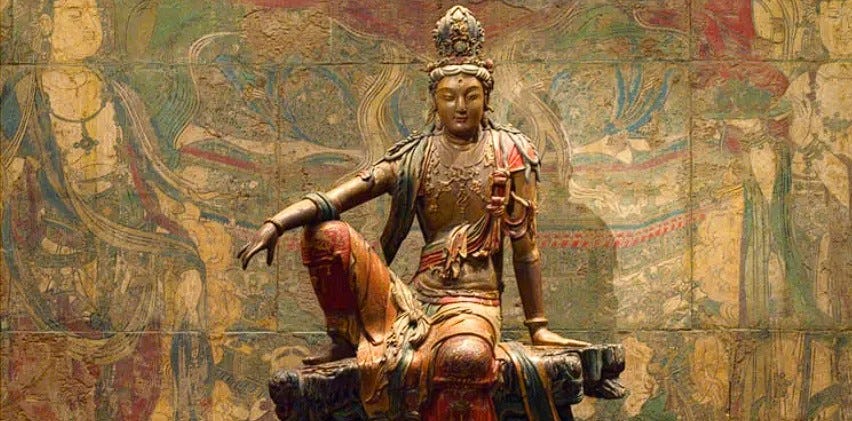
The Bodhisattva is a figure from Mahayana Buddhism. I won’t pretend expertise here. I came to it the way I came to Stoicism: sideways, out of need. What stayed with me wasn’t doctrine so much as orientation — a way of facing suffering without immediately trying to escape it.
Jack Kornfield describes a Bodhisattva as someone devoted to awakening, but unwilling to reach it alone—someone who stays. Someone who acts for the welfare of others, even when they have done more than enough for their own enlightenment, and selflessly helping others costs them well-earned comfort.
That landed uncomfortably close to teaching.
Because classrooms are full of suffering that doesn’t announce itself politely. It shows up as apathy, cruelty, noise, silence, defiance, and withdrawal. It shows up in students who are hard to like on their best days, and harder to teach on their worst. And it shows up whether you’re ready or not.
The Bodhisattva doesn’t look away from that. Doesn’t flinch. Doesn’t reduce it to “data” or “behavior management.” It recognizes that most harm is downstream from pain — and that the person in front of you is carrying more than you can see.
That posture changes how you read a room.
You stop treating behavior as a personal affront.
You stop assuming resistance is laziness.
You stop deciding, quietly, who is worth your effort.
You feel things more sharply, which is a problem.
Because staying emotionally open in a classroom hurts. There’s no way around that. If you actually let students register as human beings — not projects, not metrics, not disruptions — the work gets heavier. The Bodhisattva path isn’t soothing. It’s abrasive. It rubs against your nerves.
This is where many good teachers break.
They keep absorbing, they keep staying late. They keep taking the suffering home with them.
It’s easy to confuse compassion with availability, care with compliance. And slowly, the work eats them alive.
That’s not a failure of character. It’s a misunderstanding of the vow.
The Bodhisattva vows are often recited poetically. The Dalai Lama’s version, drawn from Shantideva, is the one that sticks with me — the image of being a lamp in the darkness, a bridge across the flood, a resting place for the weary. It’s beautiful. It’s also dangerous if read as a job description.
Nothing in that vow says you are required to destroy yourself in the process.
The Bodhisattva doesn’t promise to fix everyone. They promise to remain oriented toward care, even when outcomes are uncertain. Even when gratitude never comes. Even when the effort itself seems to vanish into the air.
In a classroom, that means something quieter than heroics.
It means you keep treating students as people even after they’ve given you reasons not to. It means you don’t write anyone off, even when you stop expecting change. It means you show up again tomorrow with your dignity intact.
And it means you learn where to stop.
This is where Stoicism and the Bodhisattva finally stop fighting each other.
Stoicism draws the boundary; the Bodhisattva decides what happens inside it.
Care without attachment.
Presence without self-erasure.
Compassion that doesn’t require applause.
That’s the only version of this work I’ve seen survive.

The Balancing Act
At some point, it became clear that neither posture could carry the room on its own.
Stoicism, on its own, kept me upright. It preserved my sanity. It gave me distance. Over time, that distance started to feel like an absence. I was present, but buffered. Calm, but sealed off. Nothing pierced far enough to matter.
The Bodhisattva posture pulled me back toward the work. It reintroduced weight. Faces. Names. Stakes. It also came with a familiar risk: staying too long, carrying too much, letting the job follow me home, and set up residence.
I didn’t arrive at a balance. I arrived at a rule.
I show up fully.
I do not chase outcomes.
That distinction changed everything.
I prepare. I teach. I explain. I correct. I offer help. I set boundaries. I do it with care and attention. What happens after that belongs to forces larger than me — students’ choices, families, timing, luck, the weather.
It’s not detachment. It’s consent.
I consent to do the work in front of me. I do not consent to be consumed by it.
Once that line is drawn, many small decisions become easier.
I can address behavior without carrying resentment, and I can offer support without monitoring gratitude. I can hold a standard without turning it into a referendum on my worth.
The classroom stops being a stage for moral drama and becomes what it always was: a place where people practice being human under constraints.
Some days the work lands, some days it evaporates. But both are survivable.
What nearly destroyed me was the belief that caring required collapse. That if I didn’t exhaust myself, I was failing. That restraint from giving my absolute last bit of energy was a form of betrayal.
It isn’t.
It’s how the work continues.
But this all comes with a warning. This posture doesn’t make you popular. It doesn’t read as inspirational. You’re not going to be hollering “Amen!” at a staff meeting. It can look suspiciously like indifference to people who benefit from your overextension.
That’s fine.
I will teach you.
I will treat you with respect.
I will not destroy myself trying to pull you across a finish line you haven’t chosen.
That’s not abandonment, it’s staying in the room long enough to matter.
But for all the work of merging these two approaches, things can go wrong…
When Compassion = Policy
Once you start holding both postures — care without attachment, boundaries without withdrawal — you begin to notice a pattern.
Leadership tends to be very comfortable with one half of that equation.
The language of compassion travels well upward. It sounds good in meetings. It fits on slides. It photographs nicely. “Do it for the kids” is difficult to argue with and easy to repeat. It feels moral. It feels urgent. It feels like leadership.
The trouble starts when compassion is treated as a resource rather than a stance.
In that framing, care becomes something to be extracted. Extra time. Extra patience. Extra flexibility. Extra forgiveness. Always extra. And because it’s framed as moral rather than contractual, it’s difficult to refuse without sounding small.
Stoic boundaries, on the other hand, don’t translate as easily. Calm refusal. Clear limits. A teacher who does the work in front of them and then stops. That posture doesn’t read as inspirational. It doesn’t perform empathy. It can feel, from a distance, like resistance.
Sometimes it’s interpreted that way directly, with something like, “Well, I guess you just don’t care about the kids.”
That sentence gets inside your head like a parasite.
It calls out your boundaries as indifference; reframes sustainability as selfishness; and turns restraint into a character flaw.
Most of the time, it isn’t even said out loud. It hangs in the room. It shows up in tone, in evaluations, in who gets praised and who gets quietly sidelined.
And it makes you ask yourself the ultimate self-recrimination question: “Wait — am I the asshole?”
No. It’s not you. It’s it.
When systems are under pressure — political, budgetary, or optics — they reach for the tools that scale. Guilt scales beautifully. Compassion language scales beautifully. Personal sacrifice is infinitely renewable — until it isn’t.
What doesn’t scale is restraint.
A teacher who says, “This is where my responsibility ends,” forces a system to confront its own limits. That’s uncomfortable. It’s much easier to celebrate those who absorb more and more until they burn out and disappear.
The irony is that the teachers most likely to be accused of not caring are often the ones trying hardest to make the work and the institution last.
They’ve learned that compassion without structure burns people out, presence requires limits, and that saying yes to everything eventually means being useful to no one.
When leadership leans too hard on the Bodhisattva posture and treats Stoicism as suspect, the system selects for martyrdom. The calm, steady teachers don’t rise. They endure. Or they leave.
None of this requires bad intentions—just unexamined incentives.
Once you see it, it’s hard to unsee. If you’re a teacher, watch for it in your next faculty meeting. It’ll be there.
Notice which forms of care get praised, and which ones make people uncomfortable.
The teachers who remain calm, boundaried, and unpanicked rarely read as inspirational — but they are often the ones who still return the next day, able to teach.
Systems that mistake endurance for indifference tend to learn the difference only after the rooms are empty, and “no one wants to teach anymore.”

On the Way Out: An Oath
The most challenging moments in teaching aren’t the loud ones. They’re the calm conversations where a reasonable request asks you to erode yourself just a little more — to be flexible, to stretch, to absorb one more thing in the name of compassion.
Stoicism helps you see the boundary. The Bodhisattva keeps you from walking away from the work. What’s missing is something that speaks at the moment you’re told to do harm for a good reason.
I’ve long thought we need something to fall back on, well, something like this:
A Hippocratic Oath for Educators
First, do no harm —
to our students, in mind, body, or spirit,
and to ourselves, through neglect or martyrdom.I will teach with care and clarity,
remembering that I can guide, not compel.I will act with compassion,
but I will not confuse compassion with self-erasure.I will hold students accountable
without contempt,
and myself accountable
without cruelty.I will respect the limits of my influence,
the dignity of my profession,
and the humanity of all involved — including my own.I will do this work honestly,
steadily,
and without surrendering my soul.
That’s the job.
Not sainthood.
Not saviorhood.
Just teaching.
Thanks for reading.
This article (along with the Frank Grimes piece) is a GIFT. Thank you for your work, your dedication, your insight.
I needed this article. Have the most difficult class of my career this far this school year. It's grueling and demoralizing--especially in a chaotic and dysfunctional school. Thank you for this. I've already shared it with four other colleagues ❤️